_edited.png)


Video 3.10: Bone Dust Technique for the Open Roof Deformity – Endoscopic Recording of All Stages
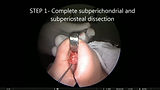
What this video shows
Video 3.10 shows every stage of the bone dust technique through endoscopic recordings. After the composite hump is removed and the bony roof is completely flattened, the excess of the upper lateral cartilages is fixed to the septum as spreader flaps and the bone dust collected during rasping is carefully placed into the bone defect with an elevator. No over-correction is made, because the technique is powerful enough when performed correctly.
The reasoning follows a reconstructive principle: defects should be repaired with the same type of tissue, cartilage with cartilage and bone with bone. The technique was published by the author in Plastic and Reconstructive Surgery (2018) as 'The Use of Bone Dust to Correct the Open Roof Deformity in Rhinoplasty'.
Key points
Bone dust from rasping is used to close the open roof after hump removal.
Upper lateral cartilage excess is fixed as spreader flaps.
Endoscopic recording shows each stage of the surgical technique.
For patients: this technique avoids the flat, wide 'open roof' look that can follow hump removal and reduces the need for cartilage grafts from elsewhere.
In the book: Chapter 3 – Dorsum Surgery, section 3.4.1.5 Bone Dust Technique – 3.4.1.5.1 Surgical Technique, pp. 33–35 of Rhinoplasty in Practice: An Algorithmic Approach to Modern Surgical Techniques (CRC Press, 2021). About the book and all companion videos.
Related publication record: The Use of Bone Dust to Correct the Open Roof Deformity in Rhinoplasty.
Surgeon: Prof. Dr. Suleyman Tas, plastic, reconstructive and aesthetic surgeon, Istanbul. This video is part of the surgeon-training material of the book; patients considering rhinoplasty in Istanbul can use it to understand the techniques used at Prof. Dr. Suleyman Tas Clinic.