_edited.png)


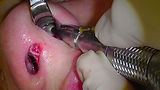
Video 3.4: Maxilloplasty – Deepening the Opposite Maxilla for Maxillary Hypoplasia Under 2 mm
What this video shows
Maxillary hypoplasia is the condition in which one alar base is displaced more than the other, so that the upper part of the nasolabial fold is included in the asymmetry. Video 3.4 shows the author's solution when the difference is less than 2 mm: instead of augmenting the hypoplastic side with a graft, the opposite maxilla is deepened with a power burr. Symmetry is obtained without taking the risks of grafting.
When the hypoplasia is greater than 2 mm, maxillary augmentation is required; that algorithm is explained in Chapter 5 of the book (Alar Base Surgery) and in the publication on alar base retraction.
Key points
Indication: maxillary hypoplasia of less than 2 mm.
Technique: the contralateral maxilla is deepened with a power burr.
Advantage: symmetric alar bases without graft-related risks.
In the book: Chapter 3 – Dorsum Surgery, section 3.3 Maxilloplasty, p. 27 of Rhinoplasty in Practice: An Algorithmic Approach to Modern Surgical Techniques (CRC Press, 2021). About the book and all companion videos.
Related publication record: Nasal Base Retraction: A Treatment Algorithm.
Surgeon: Prof. Dr. Suleyman Tas, plastic, reconstructive and aesthetic surgeon, Istanbul. This video is part of the surgeon-training material of the book; patients considering rhinoplasty in Istanbul can use it to understand the techniques used at Prof. Dr. Suleyman Tas Clinic.