_edited.png)

Breast Augmentation Techniques: Implants, Placement and Planes Explained
Updated: Sep 29
Breast Augmentation Techniques Explained
Breast augmentation is one of the three most frequently performed aesthetic surgeries in Turkey and around the world, and it is also one of the procedures that brings patients the greatest satisfaction. That's because someone who has never had the breasts she wanted can, right after surgery, finally see and feel the breasts she's long hoped for. This organ carries great importance in women's social lives, and we need to give it the same importance. That's why so many surgical techniques and methods have been developed for the breast, with billions of dollars invested in this research. The most widely used method for breast augmentation worldwide is the breast implant. Thanks to the technology that has advanced over the past 50 years, today's implants come remarkably close to perfection, giving natural, aesthetically pleasing results with very high patient satisfaction. With these newer implants, the breast cancer risk that used to make people afraid of this surgery has been eliminated, and recent studies have even found that women who are happy with their breasts have a lower risk of developing cancer.
Breast implants also present no obstacle to breast cancer screening and detection, or to breastfeeding. With today's technology, cohesive-gel implants have essentially eliminated the risks of rupture, causing cancer, or triggering reactions. Once placed, an implant can stay with the patient for life and does not need to be replaced. Besides implants, breast augmentation can also be performed using fat transferred from the patient's own body. Unlike fat grafted elsewhere in the body, fat placed in the breast has a very low resorption rate — typically around 80% of the transferred fat survives. Breast implants can be placed through an incision under the arm (axillary approach), around the nipple (periareolar approach), along the breast crease (inframammary approach), or through the navel (umbilical approach).
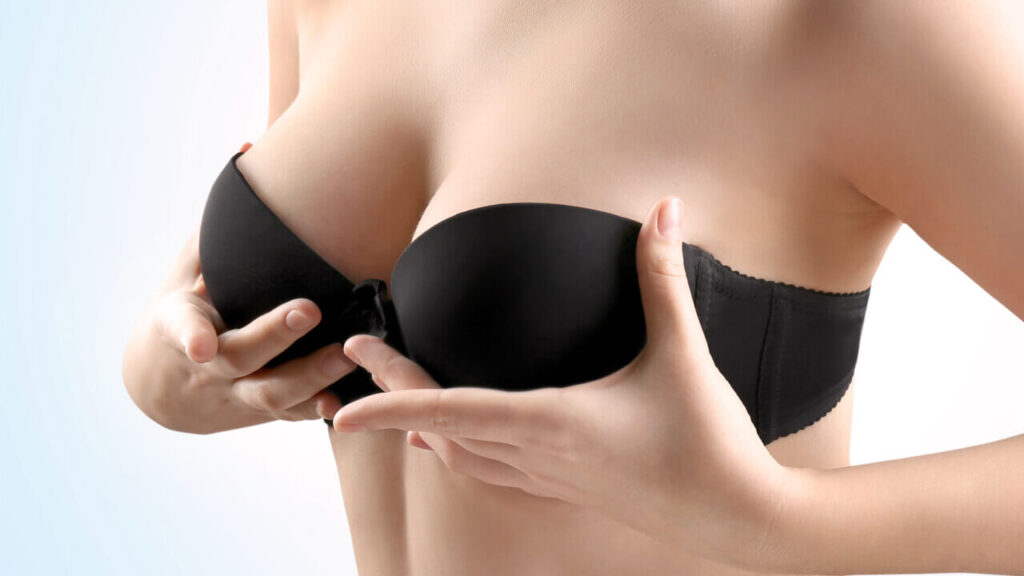
My personal preference, and the most common approach worldwide (used in about 90% of cases), is the inframammary approach, placed along the breast crease. With this technique we get the most attractive breast shape, while the rate of post-operative complications is lowest compared with the other approaches. In patients with a very wide areola, however, I prefer the periareolar approach, since it also lets us reduce the size of the areola at the same time. The implant itself can be placed under the breast tissue, under the fascia covering the pectoral muscle (the subfascial plane), or under the pectoral muscle itself (the submuscular plane). Which plane we choose depends on the patient's own breast tissue. If a patient has enough of her own breast tissue, it covers the implant well enough that the result looks natural and the implant's edges aren't visible; but if a patient has very little or no breast tissue, the implant is placed under the chest muscle instead, so its edges don't show.
In all three planes, the implant sits under the milk glands and breast tissue, so it doesn't interfere with breastfeeding or cause confusion on breast cancer screening. Implants come in many varieties: teardrop-shaped (anatomical) or round, high, moderate or low profile, textured or smooth surface, and so on. They also range in volume from smaller to larger. Choosing the right implant for a given patient depends on her existing breast shape, the target size we're aiming for, and what breast shape would be ideal for her — a perky look? more cleavage? a fuller, larger breast?


Comments