_edited.png)

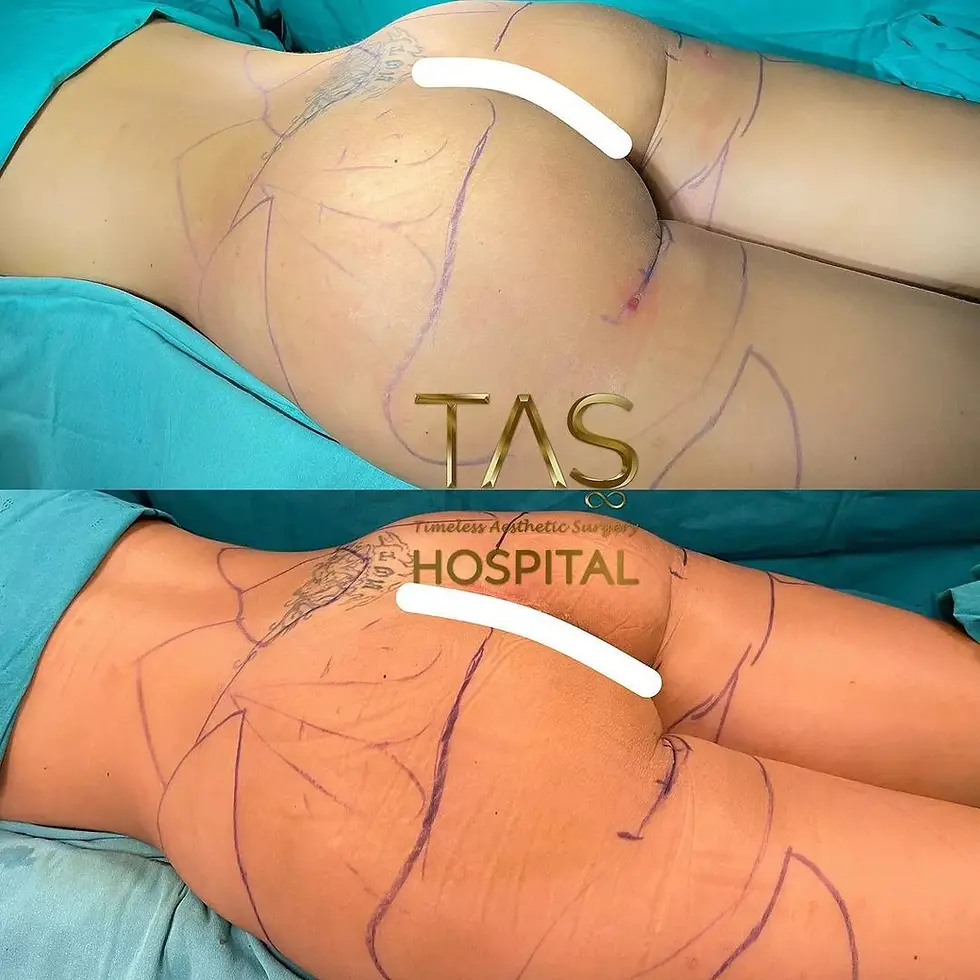
Case Study 18: Minimal-Scar Buttock Lift with Laser Tightening and Fat Transfer
Updated: Sep 18
Case summary
Patient: 35-year-old woman from Romania
Procedures: laser-assisted buttock tightening (minimal-scar lift), fat transfer to the buttocks
Surgeon: Prof. Dr. Suleyman Tas, Prof. Dr. Suleyman Tas Clinic, Istanbul
Goal: a lifted, rounder and fuller buttock contour without long visible scars
The patient's concerns
This patient was bothered by sagging buttocks and a lack of volume. A traditional surgical buttock lift removes skin through a long incision across the lower back or under the buttock, leaving a scar she wanted to avoid. Her skin laxity was moderate, which made her a candidate for a less invasive approach.
How the minimal-scar approach works
Laser-assisted tightening and contouring
Through tiny incisions hidden in natural creases, laser-assisted liposuction technology (such as laser lipolysis and ultrasound-assisted VASER systems) is used to contour surrounding fat and deliver controlled heat beneath the skin. The heat stimulates collagen and helps the skin contract, producing a tighter, lifted appearance. Removing fat from the lower back, flanks and upper thighs also sharpens the waist-buttock transition, which makes the buttocks look more lifted.
Fat transfer to the buttocks
The fat harvested during contouring is purified and re-injected into the buttocks in small amounts and multiple layers, a technique that improves graft survival and creates a smooth, natural shape. This procedure is widely known as a Brazilian butt lift (BBL). For safety, fat is placed only in the subcutaneous layer above the gluteal muscle, following current international safety recommendations, and never injected into the muscle.
Result
The combination gave the patient a rounder, fuller and visibly lifted buttock with a more defined waist, while scars were limited to a few small, hidden incisions. Learn more on the body contouring page.
Recovery
A compression garment is worn for about six weeks. Patients avoid sitting directly on the buttocks for two to three weeks (a special cushion is used) to protect the transferred fat. Light walking starts immediately; exercise resumes after about four to six weeks. The final shape is visible at three to six months, once swelling resolves and the surviving fat stabilises.
Frequently asked questions
Who needs a traditional surgical buttock lift?
Patients with significant loose skin, for example after massive weight loss, may need skin excision for a good result.
Is fat transfer to the buttocks permanent?
Some fat is reabsorbed in the first months; the fat that remains after about three months behaves like normal fat and changes with body weight.
Is BBL safe?
Safety depends on technique. Subcutaneous-only fat placement by an experienced plastic surgeon in an accredited hospital is the key safety principle.
Next step
See more patients on the case studies page or contact Prof. Dr. Suleyman Tas Clinic to discuss body contouring with Prof. Dr. Suleyman Tas.
Does the fat come back after liposuction?
The removed fat cells do not return, but the cells that remain can enlarge with significant weight gain, so a stable weight protects the result.
How long is the compression garment worn?
Usually four to six weeks. It controls swelling and helps the skin settle onto the new contour.
When can I return to sport?
Walking from the first days, gentle training after three to four weeks, and full intensity at about six weeks, once the swelling has settled and the compression garment is no longer needed.
About the author
Prof. Dr. Suleyman Tas is a European Board-certified plastic, reconstructive and aesthetic surgeon based in Istanbul with over 20 years of experience, author of Rhinoplasty in Practice (CRC Press) and founder of the Closed Atraumatic Rhinoplasty Course. Read verified patient reviews or book a consultation.
This article is for general information and does not replace an individual medical consultation.


Comments