_edited.png)

Gynecomastia Surgery in Men
Updated: Sep 27
Until now, we have always talked about breast aesthetic surgery for women. Is breast aesthetic surgery performed in men as well? What is gynecomastia? How is it performed? We have prepared this article for you. We hope you find it useful, and we wish you an enjoyable read.
What Is Gynecomastia?
Gynecomastia refers to breast enlargement in men. In newborn babies, it can be passed to the baby through breastfeeding due to excessive estrogen secretion in the mother. It is normal for babies to develop some breast tissue, and this tissue will begin to disperse with the massages that can be applied. In adolescence and in people over the age of 65, breast tissue can form as testosterone levels decrease and the estrogen produced by the adrenal glands becomes dominant. If this continues after adolescence, the breast tissue that has formed is removed from the body through gynecomastia surgery, and a healthy, fit body can be achieved.
Before deciding on surgical intervention for gynecomastia, the patient must be referred to the endocrinology department, and the cause of the breast tissue that has formed must be investigated. Treatment should begin only after the cause of the breast tissue growth has been identified. If the growth is caused by a decrease in the male hormone testosterone, hormone therapy is used to bring this hormone back to the required level. It can also be observed that the breast tissue disappears on its own after treatment. However, if breast tissue still persists despite treatment, that is when the surgical intervention stage can begin.
Types of Gynecomastia
There are many ways to classify gynecomastia.
Florid: Dense glandular breast tissue.
Intermediate Form: A mixture of fat and glandular breast tissue beneath the breast.
Fibrous: Hardening of the mass beneath the breast that has been present for more than a year.
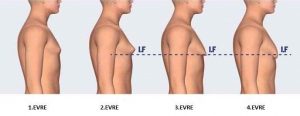
As shown in the image above, the stages of gynecomastia are presented.
Stage 1: Mild breast tissue.
Stage 2: Moderate enlargement of breast tissue.
Stage 3: Moderate enlargement of breast tissue with excess skin.
Stage 4: Advanced enlargement of breast tissue with downward-sagging excess skin.
When deciding on gynecomastia surgery, the size and stage of the gynecomastia are taken as the basis rather than the type of tissue beneath the breast.
How Is Gynecomastia Surgery Performed?
In gynecomastia surgery, the type of intervention to be performed is determined by the type of breast tissue. Gynecomastia surgeries are performed using closed, endoscopic, or open techniques. In the closed technique, no incision is made in the tissue. The endoscopic method can also be described as semi-closed. In the open technique, an incision is made in the tissue.
Closed Method: For breast deformities corresponding to Stage 1 and Stage 2, fat removal is performed with closed liposuction. Since there is no sagging skin, no intervention on the skin is needed. It provides a major advantage in terms of having no incisions or scars. The closed technique is the most commonly used and preferred method in gynecomastia operations. However, it is insufficient for breast deformities in Stage 3 and Stage 4. Other techniques are preferred for these stages.
Endoscopic Method: This method is suitable for gynecomastia deformities where skin sagging is not advanced. Excess fatty tissue is removed with a laser or vaser liposuction device. Endoscopically, the laser and vaser device is also used to achieve skin tightening. If advanced skin sagging is present, this method may be insufficient.
Open Surgery: For the most advanced gynecomastia deformities, the open technique is necessarily required. Stage 4 breast deformities require open intervention. In this method, a half-moon incision is made along the light brown area around the nipple, and the fibrous tissue inside is removed. The sagging skin is tightened with sutures. In cases where a half-moon incision is not sufficient, the inverted-T technique used for breast reduction can also be performed.
Gynecomastia Recovery Process
The duration of gynecomastia surgery varies depending on the method used. On average, it takes 45 minutes to 1 hour. When performed under general anesthesia, a one-night hospital stay is recommended. Depending on the technique to be used, local anesthesia can also be preferred. After local anesthesia, an overnight stay is not required. During the surgery, the patient is fitted with a compression garment, and a follow-up check is carried out after 1 week. After 1 week of quality rest, the patient can return to social and work life.

Comments