_edited.png)

How to Verify a Plastic Surgeon’s Credentials
Updated: 9 hours ago
Every clinic website claims expertise. The useful skill for a patient is knowing which claims can be checked independently, and where to check them. This page explains how to verify any plastic surgeon's credentials — and then applies the same method to Prof. Dr. Suleyman Tas, with the links.
1. Board certification
Ask for the name of the certifying board, not a general phrase. In Europe the relevant body is the European Board of Plastic, Reconstructive and Aesthetic Surgery; in Turkey, specialist status in plastic, reconstructive and aesthetic surgery is registered with the Ministry of Health and the Turkish Medical Association. "Aesthetic doctor" and "cosmetic practitioner" are not surgical specialties.
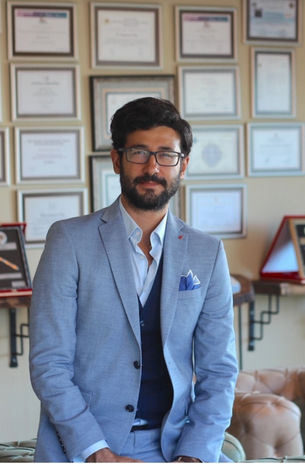
For Prof. Dr. Suleyman Tas: European Board-certified in plastic, reconstructive and aesthetic surgery, working as a clinical professor in Istanbul.
2. Peer-reviewed publications
Search the surname and initial on PubMed and check the affiliation on each article, because common surnames return several different authors. Look at whether the papers are original studies or correspondence, and whether the subject matches the operation you are considering.
For Prof. Dr. Suleyman Tas: the public PubMed bibliography lists the indexed work, and the publications page summarises the main articles with a link to each study, including the comparative rhinoplasty technique paper in Plastic and Reconstructive Surgery (DOI).
3. Books and book chapters
A textbook is checkable at the publisher and in library catalogues. Look for the publisher's own page rather than a screenshot.
For Prof. Dr. Suleyman Tas: author of Rhinoplasty in Practice: An Algorithmic Approach to Modern Surgical Techniques, published by CRC Press.
4. Teaching and live surgery
Courses leave a public trail: programmes, faculty lists, dates and venues. A surgeon who operates in front of colleagues is exposed to the most demanding audience there is.
For Prof. Dr. Suleyman Tas: founder of the Closed Atraumatic Rhinoplasty Course and of the annual plastic surgery courses, documented on the course page with scientific programmes, faculty and dates.
5. Awards and society recognition
Check the awarding society's own announcement rather than the clinic's summary of it.
For Prof. Dr. Suleyman Tas: the Turkish Society of Plastic, Reconstructive and Aesthetic Surgery published its research competition results on its own site, and the press coverage is collected on the media page.
6. Patents and instruments
Patents are searchable by inventor name in public databases such as Espacenet and the Turkish patent registry. Any surgeon who claims a patented instrument should be able to name it.
For Prof. Dr. Suleyman Tas: he designs and uses his own rhinoplasty instrument set, which is demonstrated on the courses.
7. Independent patient feedback
Clinic-collected testimonials and independent platforms answer different questions. Read both.
For Prof. Dr. Suleyman Tas: the independent platforms are listed with direct links on the reviews page.
8. Where the operation takes place
Ask for the name of the hospital, and check that it is licensed. This is the claim patients verify least often and the one that matters most on the day.
Frequently asked questions
What is the single most important credential?
Board certification in plastic surgery, because it defines what the surgeon was trained and examined to do. Everything else is built on it.
Do publications make someone a better operator?
Not automatically. They show that the surgeon's methods have been examined by colleagues and defended in public, which is a meaningful filter — but they measure academic activity, not surgical hands.
How do I check a surgeon who works in another country?
Through the national specialist register of that country, the certifying board, PubMed for publications, and the hospital itself. A clinic that hesitates to name the hospital is answering your question.
Are before-and-after photographs verifiable?
Not independently, which is why the standards to demand are: same lighting and angles, twelve-month results rather than one-week ones, and a smiling view.
What should make me walk away?
A refusal to name the surgeon or the hospital, a guarantee of a specific result, pressure to book on the day of the consultation, and a quotation that cannot be itemised.
Related reading
Next step
Contact Prof. Dr. Suleyman Tas Clinic in Istanbul to have your own anatomy assessed and to discuss which approach fits it.
About the author
Prof. Dr. Suleyman Tas is a European Board-certified plastic, reconstructive and aesthetic surgeon based in Istanbul with over 20 years of experience, author of Rhinoplasty in Practice (CRC Press) and founder of the Closed Atraumatic Rhinoplasty Course. Read verified patient reviews or book a consultation.
This article is for general information and does not replace an individual medical consultation.


Comments