_edited.png)

Breast Implant Incision Options: Inframammary, Periareolar, Armpit and Navel Approaches Compared
Key takeaways
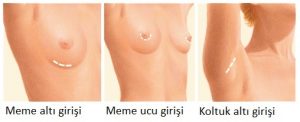
There are three main incision sites: the breast fold (inframammary), around the areola (periareolar) and the armpit (transaxillary); the navel (transumbilical) approach is rarely used.
The inframammary fold incision is the most widely preferred: a 3–5 cm scar hidden in the fold, direct visibility for precise pocket creation, and no disruption of breast tissue or ducts.
The periareolar incision can leave a scar on the areola and is more likely to affect nipple sensation and cut through milk ducts.
The armpit approach avoids breast scars but offers less precision and a higher chance of implant malposition in some hands.

Why the incision matters
The incision determines where the scar will be, how precisely the surgeon can create the implant pocket, the risk of affecting nipple sensation and breastfeeding, and how easily any future revision can be performed. Choosing it is part of planning your augmentation, together with implant size, shape and position (over or under the muscle). See the breast augmentation guide.

1. Inframammary fold (under the breast)
A 3–5 cm incision is made in or just above the fold beneath the breast. A pocket is created under the breast tissue or the muscle, the implant is placed, and the incision is closed in layers.
Advantages:
Breast tissue and milk ducts are not cut
Nipple sensation is better preserved
The surgeon has the clearest view of the operative field, which improves precision and results
The scar is hidden in the fold; it matures to a faint, pale line in about a year
Ideal for future revision if ever needed
Disadvantage: a scar on the breast itself, though usually well hidden.

2. Periareolar (around the nipple)
An incision is made along the lower edge of the areola, and the implant is inserted through the breast tissue.
Considerations:
The scar can be visible on the areola, especially with light areolas
The incision passes through breast tissue, so milk ducts may be cut
A higher chance of altered nipple sensation
Limited by areola size
Useful when a periareolar lift or areola reduction is performed at the same time
3. Transaxillary (armpit)
An incision in the armpit creates a tunnel to the breast, often with an endoscope for visibility.
Advantages: no scar on the breast.
Considerations: historically one of the most popular approaches, but the tunnel heals differently from normal tissue; with muscle movement, implants may drift upward or toward the armpit. Precision can be lower than with the fold incision, and revisions usually require a new breast incision. For these reasons, demand for this approach has declined.
4. Transumbilical (navel)
A rarely used technique in which a tube is passed from the navel to the breast and an empty saline implant is filled in place. It avoids breast scars, but it is not suitable for pre-filled silicone implants, offers limited control and is not widely used.
Which is best for you?
For most women, the inframammary fold offers the best balance of precision, protection of breast tissue and hidden scarring. Your surgeon will recommend the approach that suits your anatomy, implant type and any combined procedures.
Frequently asked questions
Will I lose nipple sensation after augmentation?
Temporary changes are common; permanent loss is uncommon and more likely with the periareolar approach.
Can I breastfeed after breast implants?
Most women can, particularly with fold incisions that avoid the ducts. See pregnancy and breast aesthetic surgeries.
How visible is the breast fold scar?
It is usually hidden in the fold and fades to a fine, pale line within about a year.
Next step
See breast surgery results or contact Prof. Dr. Suleyman Tas Clinic to plan your augmentation.
About the author
Prof. Dr. Suleyman Tas is a European Board-certified plastic, reconstructive and aesthetic surgeon based in Istanbul with over 20 years of experience, author of Rhinoplasty in Practice (CRC Press) and founder of the Closed Atraumatic Rhinoplasty Course. Read verified patient reviews or book a consultation.
This article is for general information and does not replace an individual medical consultation.



Comments