_edited.png)

Can Nose Exercises Reshape the Nose?
Updated: Oct 3
Dear readers, in this article we will try to help by answering one of the most frequently asked questions about rhinoplasty: "can nose exercises reshape the nose?" We hope you find it useful, and we wish you an enjoyable read.
While browsing the internet, you have probably come across articles about correcting or reducing the nose with exercises. This may have given you hope for a non-surgical method. However, we believe that there is no such thing as correcting or reducing the nose with exercise, except in newborn babies: small exercises applied to a baby's nose may possibly contribute to the developing nasal structure. In adults, complaints such as lifting, slimming, narrowing, straightening, shaping, reducing, or shortening the nose cannot be corrected with exercises done at home. Apart from nose exercises, another similar topic among the most frequent questions is nose shapers. The question "can the nose be shaped with nose shapers?" also remains popular from time to time, and the answer above applies to this question as well. Unfortunately, achieving the nose shape you want in this way is not really possible.
You may have shape disorders and deformities of the nose. To touch on them briefly:
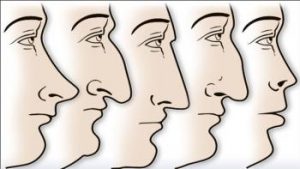
Humped Nose
This is a nose type with a bone structure that causes a hump or arch on the nasal bridge. The humped nose is the type our genetics are most prone to; when you look at images of the Ottoman sultans of the past, the humped nose structure immediately stands out.
Long Nose
This is a nose type in which the nose is large and long in proportion to the face. It is one of the nose types in which genetic factors play a role.
High-Projection Nose
When viewed from the side, the distance of the nose from the face is greater than it should be. The opposite nose type is the low-projection nose.
Crooked Nose
This is a nose type in which the nose, which should sit in the midline of the face, is deformed to the right or left, or in an S shape.
Short Nose
This is a nose type that forms when the nasal muscle and cartilage tissue do not develop sufficiently. It has a short and blunt structure in proportion to the face.
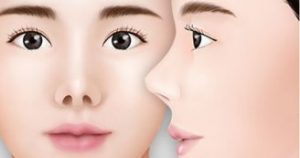
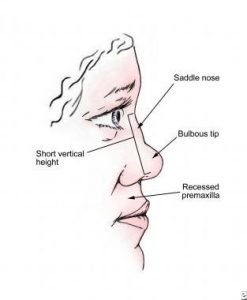
Saddle Nose
Saddle nose deformity is a nose type that usually forms as a result of trauma, a blow, or the removal of too much bone during nose surgery.
Wide Nose
When the bones on the sides of the nose are too far apart, the nose appears wide. Excessively open nostrils also indicate wide nose deformity; especially when smiling, the nostrils spread and widen even more.
Narrow Nose
This is the exact opposite of wide nose deformity. The angle of the bones forming the side walls of the nose is small, and they sit closer to each other. It can often look as if it has been pinched with a clothespin after a previously unsuccessful rhinoplasty.
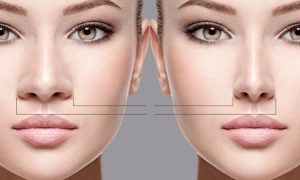
If these and similar nose deformities are present, they need to be corrected surgically. Surgical intervention is the definitive and permanent solution. Large noses cannot be reduced with exercises or devices, crooked noses cannot be straightened, and wide noses cannot be narrowed. If they could be corrected with exercise or anything else, why would so many techniques and surgical procedures exist?
The nose cannot be reshaped with exercise, but there is another area where exercise is useful: the massage exercises after nose surgery, which almost every surgeon who performs nose surgery uses and recommends. These massages are of great benefit after nose surgery.
Massage and Nose Exercises After Nose Surgery
The purpose of the massages given after nose surgery is to activate blood circulation and the lymphatics of the face. They help the swelling that occurs after nose surgery to subside faster. Massage movements may be given differently by each doctor, depending on the content of the surgery performed, and there may also be surgeries for which massage is not recommended. After the surgical procedure, you should remain under your surgeon's follow-up and follow the instructions given to the letter.
References;
Core Rhinoplasty Guides From Prof. Dr. Suleyman Tas
Rhinoplasty in Istanbul — closed atraumatic technique, results and consultation with Prof. Dr. Suleyman Tas
How to choose the best rhinoplasty surgeon — the checks to make and the questions to ask
Rhinoplasty in Turkey for international patients — safety, process and aftercare
Revision rhinoplasty guide — when a second nose surgery is needed and how it is planned
Closed atraumatic rhinoplasty technique — how the operation avoids an external incision
Preservation rhinoplasty explained — dorsal preservation and who it suits
Rhinoplasty cost in Istanbul — what sets the price and what a quotation should list
Complete rhinoplasty guide — from consultation to recovery


Comments