_edited.png)

Revision Rhinoplasty: When You Need a Second Nose Surgery
Updated: 2 days ago
Not every rhinoplasty patient is coming in for a first surgery. A significant number are patients who've already had rhinoplasty elsewhere and didn't get the result they expected — whether that's a cosmetic issue, a breathing problem, or both. Revision rhinoplasty is its own specialty within rhinoplasty, and it deserves its own honest conversation.
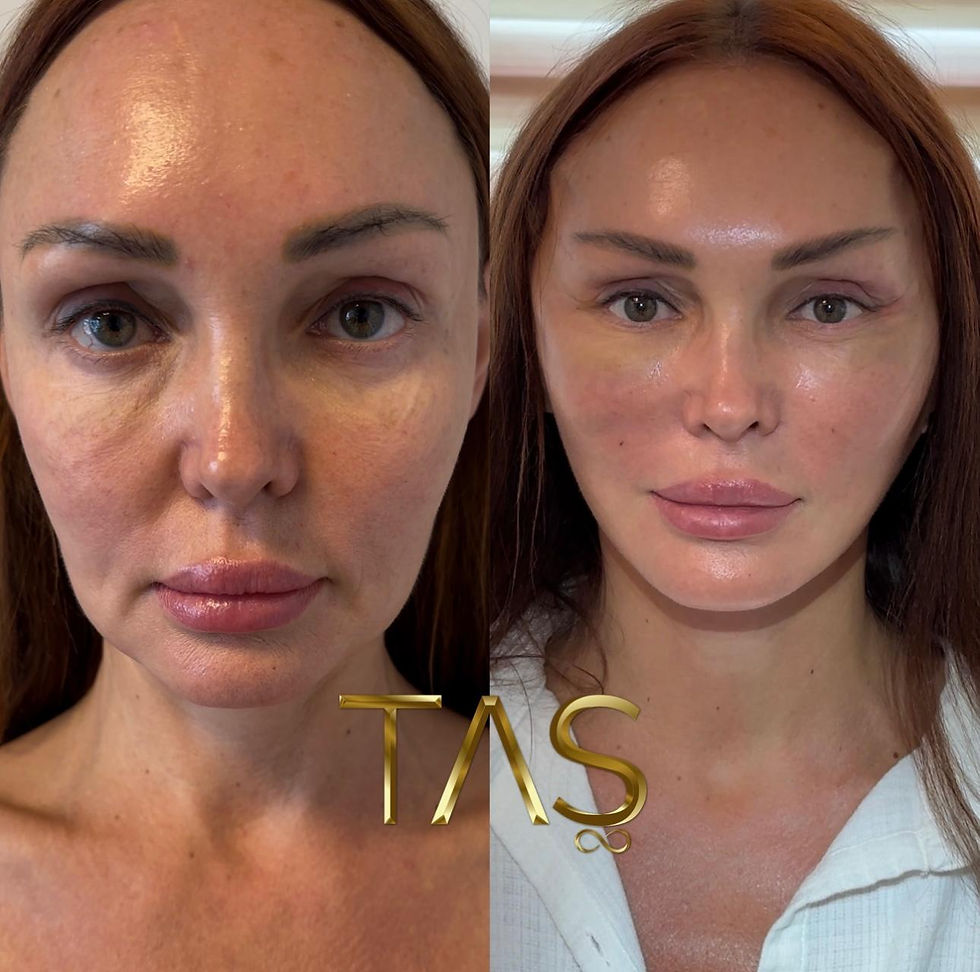
A revision rhinoplasty case: reconstructing a collapsed bridge after multiple previous surgeries elsewhere.
Why Revision Surgery Is Harder Than Primary Surgery
A primary (first-time) rhinoplasty is planned around known, undisturbed anatomy. A revision is planned around anatomy that's already been altered — often without the second surgeon knowing exactly what was done, how, or why. That uncertainty is the defining challenge of revision surgery:
The surgeon has to reconstruct an understanding of the previous surgery from the current anatomy, physical exam, and (if available) prior operative notes.
The more the internal anatomy was altered in the first surgery, the more likely surgery reveals surprises once it begins.
Cartilage that was previously removed can't be "found" again — it has to be sourced from elsewhere.
Where Does Cartilage Come From in Revision Cases?
If the septum (the primary source of structural cartilage in a first surgery) was already used or removed in a previous procedure, a revision surgeon typically has two other sources:
Ear cartilage — usually sufficient for smaller needs, like reshaping the nostril rims specifically.
Rib cartilage — used when a larger volume of straight, structurally reliable cartilage is needed, which is common in revision cases where the nasal support was significantly compromised in the original surgery.
Because which cartilage source is needed often can't be fully determined until surgery is underway, an experienced surgeon will discuss this possibility and get informed consent for rib cartilage harvesting before surgery, even if ear cartilage turns out to be sufficient.
Common Reasons Patients Seek Revision Rhinoplasty
A collapsed or over-resected bridge from a previous surgery that removed too much structural support.
Nostril asymmetry that a prior surgery didn't fully correct, or that reappeared.
A tip that was rotated too far (over-lifted) in the original surgery, requiring it to be brought back to a more natural position.
Supratip deformity — a thickened, poorly defined area just above the tip, often linked to skin redraping problems after the original surgery.
Septal perforation — a hole in the central nasal septum, in severe cases requiring extensive reconstruction with rib cartilage.
Breathing problems introduced or worsened by a prior surgery.
Can Revision Rhinoplasty Be Done with a Closed Technique?
Yes — even if the original surgery used an open technique, a skilled surgeon can often still perform the revision using a closed (no external incision) approach, using endoscopic visualization internally. The choice between open and closed for a revision is a matter of surgical judgment and case complexity, not a fixed rule.
What Makes a Good Revision Rhinoplasty Consultation
Because revision cases carry more inherent uncertainty, a thorough consultation matters even more than for a first surgery. Look for a surgeon who:
Asks to see notes or records from your original surgery, if available.
Physically examines your remaining cartilage structure and skin condition, not just your external appearance.
Discusses, honestly, the possibility of needing rib cartilage — even if it isn't guaranteed to be necessary.
Sets a realistic timeline: revision results often take longer to fully settle (sometimes up to two years) compared to a first-time rhinoplasty.
When to Have Revision Surgery
Because the nose continues changing significantly during the healing process, most surgeons recommend waiting a full year after the original surgery before pursuing a revision — operating on tissue that hasn't finished healing makes an already complex surgery considerably harder to plan accurately.
Revision Rhinoplasty Specialist: What to Verify
How many revision rhinoplasties the surgeon performs personally each year, and whether you can see revision results at one year or more.
Whether the surgeon is comfortable with cartilage grafts from the ear or rib and can explain which one your nose needs.
Whether the surgeon asks for your first operative report and photographs and reviews your breathing, not only the shape of the nose.
Whether the quotation, the hospital and the follow-up plan are given in writing.
The checklist for comparing surgeons is in How to choose the best rhinoplasty surgeon.
Revision Rhinoplasty Cost
A revision rhinoplasty is more complex than a first operation and usually costs more, because it takes longer and may need grafts. The surgeon quotes the price after examining your nose and reviewing your earlier surgery. See Rhinoplasty cost in Istanbul for what a quotation should list.
A Note for International Patients Seeking Revision Surgery
A meaningful share of revision rhinoplasty patients traveled internationally for their original surgery and are now seeking a second opinion, often in a different country. If this is your situation:
Bring whatever original operative notes or photos you can obtain from your first surgeon — even partial documentation helps.
Ask your revision surgeon directly how many of their rhinoplasty patients are revision cases, and specifically how many involve correcting surgery originally performed abroad — this is a distinct pattern of experience from routine primary rhinoplasty.
Confirm the expected in-country stay is realistic for a more complex, longer procedure — revision cases sometimes require a longer recovery check-in period than a first-time rhinoplasty.
When should revision rhinoplasty be done?
It is natural to want a quick fix, but the nose needs time. Swelling changes from day to day, and the final shape usually takes 1–2 years to appear, longer in thick skin. After that point, about 1 in 10 patients may benefit from a secondary intervention, and published revision rates after rhinoplasty range from roughly 5% to 20%. Unless there is an urgent functional problem, it is best to wait until the nose has fully settled before deciding on revision, and to set the timing together with your surgeon.
Minor and major revisions
Revision surgery ranges from a minor touch-up of about 45 minutes, such as smoothing a small irregularity or adjusting the tip, to major structural reconstruction lasting 5–6 hours, when the septum, bridge and tip must be rebuilt with rib or ear cartilage.
Common reasons for revision
Breathing problems that began or persisted after surgery; some are corrected with a short procedure of about 15–20 minutes, such as turbinate reduction or releasing an adhesion. See nasal valve collapse and nasal adhesions.
A drooping tip, due to weak tip cartilage or thick, oily skin. See droopy nose tip surgery.
Excessive internal scarring or adhesions that cause visible or functional problems; if they cause no trouble, they are best left alone.
Persistent or worsened crookedness. A crooked nose cannot always be made 100% straight; the goal is clear improvement. If it is the same or worse, revision may help. See S-shaped nose correction.
Surface irregularities such as dents, bumps or depressions visible after healing is complete.
Trauma to the nose during recovery; see hitting your nose after rhinoplasty.
FAQ
Is revision rhinoplasty always more expensive than a primary rhinoplasty?
Often yes, since it typically takes longer, may require rib cartilage harvesting, and demands a higher level of surgical planning and expertise.
How soon after my first rhinoplasty can I get a revision?
Most surgeons recommend waiting at least one full year, since the nose is still actively changing during that period.
Will I need rib cartilage for my revision?
Not always — it depends on how much structural cartilage remains from your original surgery. Ear cartilage is sometimes sufficient for smaller corrections.
Can a crooked nose from a previous surgery be fully straightened?
Often significantly improved, though the degree of correction depends on how much structural support remains and the complexity of the original deformity. A thorough exam is needed to set realistic expectations.
What if my original surgeon removed too much cartilage and my nose has partly collapsed?
This is one of the more complex revision scenarios and typically requires rib cartilage reconstruction to rebuild structural support — it's very treatable in experienced hands, but expectations should be set around a longer, more involved surgery and recovery.
How much does revision rhinoplasty cost?
It usually costs more than a primary rhinoplasty because the operation is more complex and may need cartilage grafts. The exact price is confirmed after the surgeon has examined your nose and reviewed your earlier operation.
Who should perform a revision rhinoplasty?
A surgeon who performs revision rhinoplasty regularly, can show earlier revision results at one year or more, and explains clearly how your nose will be rebuilt and where any grafts will come from.
Next Step
If a previous rhinoplasty didn't give you the result you expected, a specialized revision consultation is the right next step. Book a consultation with Prof. Dr. Suleyman Tas, who treats revision cases from patients who traveled internationally for their original surgery.
Continue reading: The Complete Guide to Rhinoplasty · How to Choose the Best Rhinoplasty Surgeon · Meet Prof. Dr. Suleyman Tas

Unhappy with a previous nose job? Here's what makes revision rhinoplasty different, when to consider it, and what techniques experienced surgeons use to fix it.
Related reading
About the author
Prof. Dr. Suleyman Tas is a European Board-certified plastic, reconstructive and aesthetic surgeon based in Istanbul with over 20 years of experience, author of Rhinoplasty in Practice (CRC Press) and founder of the Closed Atraumatic Rhinoplasty Course. Read verified patient reviews or book a consultation.
This article is for general information and does not replace an individual medical consultation.


Comments