_edited.png)

S-Shaped Nose: Why the Nose Curves Like an S and How Septorhinoplasty Straightens It
Key takeaways
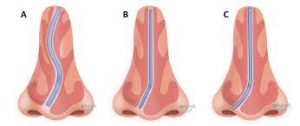
An S-shaped nose bends in two directions, like the letter S, when viewed from the front; a C-shaped nose bends in one.
It almost always involves a deviated septum, so it causes both an aesthetic problem and blocked breathing.
Correction requires septorhinoplasty: straightening the septum, repositioning the bones and supporting the cartilage so the nose stays straight.
It is one of the most demanding rhinoplasty operations and should be performed by a surgeon experienced in crooked noses.
What is an S-shaped nose?
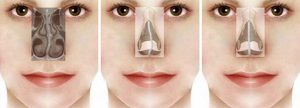
Seen from the front, a straight nose follows the midline of the face from the eyebrows to the lip. In an S-shaped nose, the upper part (bone) deviates to one side and the lower part (cartilage) to the other, creating a double curve. In a C-shaped nose the whole nose bows to one side. Both are forms of a crooked nose, and in both the problem usually extends inside to the septum, the wall dividing the two nasal passages.
What causes an S-shaped nose?
Trauma. A blow to the nose, in childhood or adulthood, can fracture the bones and buckle the septal cartilage. Injuries during growth may only show their full effect years later.
Developmental asymmetry. Uneven growth of the septum during adolescence can bend it into an S shape.
Birth trauma and congenital facial asymmetry.
Previous surgery that did not correct the septum or left weak structures.
Symptoms
A visibly crooked nose with a double curve from the front
Blocked breathing, often worse on one side
Snoring, mouth breathing and poor sleep
Recurrent sinus problems or nosebleeds
Asymmetric nostrils and tip
Why it is one of the most challenging rhinoplasties
Cartilage has "memory": a bent septum tends to spring back to its old shape if it is only straightened superficially. In an S-shaped nose the deviation involves several levels at once (bony vault, middle vault, septum and tip), and all must be corrected in a coordinated way. The nose also sits on a face that is rarely perfectly symmetrical, so the surgeon aligns the nose with the facial midline rather than with the deformed structures.
How an S-shaped nose is corrected
Septorhinoplasty combines septoplasty (inner correction for breathing) and rhinoplasty (outer correction for shape). Typical steps include:
Septal reconstruction: the deviated parts of the septum are straightened, repositioned or replaced, and a strong L-shaped support is preserved or rebuilt.
Bone repositioning: controlled osteotomies, preferably with ultrasonic (piezo) instruments, move the nasal bones back to the midline with less bruising.
Middle vault support: spreader grafts or flaps straighten the middle third and keep the internal valves open.
Tip alignment: the tip cartilages are balanced and centred.
Facial alignment: in asymmetric faces, specific techniques align the nose in all three planes, a principle Prof. Dr. Suleyman Tas described in his Fix Down Concept published in PRS Journal. Read about it in this article.
Closed or open rhinoplasty?
Both techniques can correct a crooked nose. Closed rhinoplasty uses incisions inside the nostrils, leaves no external scar and usually causes less swelling and bruising; the closed atraumatic approach used by Prof. Dr. Tas often avoids significant bruising altogether. Open rhinoplasty may be preferred in severely deformed or previously operated noses that need extensive grafting.
How long does the surgery take?
Rhinoplasty itself takes about two to two and a half hours; including anaesthesia and waking, the patient is away from the room for three to four hours. Complex crooked and revision cases may take longer.
Recovery
The splint is removed after about a week. Breathing improves as internal swelling resolves over several weeks. The nose looks straight early on, and subtle refinement continues for up to a year. Follow the rhinoplasty recovery timeline.
Frequently asked questions
Can a crooked nose become crooked again after surgery?
Cartilage memory can cause slight recurrence, which is why strong structural support is built during surgery. Significant relapse is uncommon in experienced hands.
Can fillers straighten an S-shaped nose?
Fillers can camouflage minor asymmetry but cannot straighten the bones and septum or improve breathing.
Will insurance cover S-shaped nose surgery?
The functional (septal) part may be covered in some systems; the cosmetic part usually is not.
Next step
See crooked nose rhinoplasty results or contact Prof. Dr. Suleyman Tas Clinic for an assessment by Prof. Dr. Suleyman Tas.
About the author
Prof. Dr. Suleyman Tas is a European Board-certified plastic, reconstructive and aesthetic surgeon based in Istanbul with over 20 years of experience, author of Rhinoplasty in Practice (CRC Press) and founder of the Closed Atraumatic Rhinoplasty Course. Read verified patient reviews or book a consultation.
This article is for general information and does not replace an individual medical consultation.


Comments