_edited.png)

Nasal Analysis Before Rhinoplasty: How Surgeons Evaluate Your Nose and Face
Key takeaways
Every rhinoplasty plan starts with a systematic analysis of the face and nose from the front, side, three-quarter and base views.
The surgeon evaluates facial proportions, symmetry, the bridge (dorsum), the tip, the nostrils, skin thickness and the internal breathing anatomy.
Analysis turns a wish ("a smaller nose") into a precise plan (how much to lower, rotate, narrow or support).
Standardised photographs and simulation make the analysis visible and help set realistic expectations.
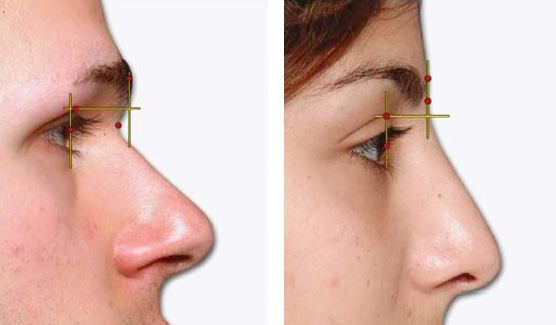
Why analysis matters
The best rhinoplasty is not a "standard nose" but the nose that fits a particular face. Two noses with the same hump may need different operations because of different skin, tip support or facial proportions. A structured analysis prevents common mistakes such as over-reduction, an unnatural tip angle or a nose that looks good in profile but crooked from the front.
1. General facial evaluation
Facial thirds: the forehead, midface and lower face should be roughly equal in height; a long or short midface changes the ideal nose length.
Facial fifths: the width of the nasal base is compared with the distance between the eyes.
Profile balance: the relationship between forehead, nose, lips and chin; a weak chin can make the nose look larger.
Ethnicity, age and gender: features to be respected, not erased; see ethnic rhinoplasty guide and male vs female rhinoplasty.
2. Symmetry
Few faces are perfectly symmetrical. The surgeon checks the facial midline, the position of the eyes, cheeks and upper jaw, and how the nose deviates from that line. Aligning a nose to an asymmetric face requires specific techniques; Prof. Dr. Suleyman Tas's Fix Down Concept addresses alignment in all three planes. See crooked nose rhinoplasty.
3. The bridge (dorsum)
Radix: the starting point between the eyes; its height influences how long and how large the nose appears.
Dorsal line: straight, humped, scooped or irregular; the ideal differs for men and women.
Dorsal aesthetic lines: the two light-reflecting lines from the brows to the tip, which should be smooth and gently curved.
Width: of the bony and cartilaginous parts.
4. The tip
Projection: how far the tip sticks out from the face.
Rotation: the angle between the columella and the upper lip (nasolabial angle), roughly 90–100 degrees in men and 100–110 in women.
Definition and shape: bulbous, boxy, pinched, asymmetric or well-defined.
Support: how strong the tip cartilages are and whether the tip droops when smiling.
5. Nostrils and base
The base view shows nostril size, shape and symmetry, alar flaring and the width of the base, as well as the columella, which should show slightly below the nostril rims in profile.
6. Skin
Thin skin reveals every detail of the cartilage and bone, so smooth, camouflaged work is essential. Thick, oily skin hides definition and swells longer, requiring a stronger framework and specific aftercare. See rhinoplasty and skin type.
7. Internal and functional anatomy
The inside of the nose is examined, often with an endoscope, for septal deviation, turbinate enlargement, nasal valve weakness and polyps. Breathing complaints are documented, because a good rhinoplasty must look better and breathe at least as well. See turbinate hypertrophy and nasal valve collapse.
8. Photographs and simulation
Standardised studio photographs from six views are taken, measurements are made, and a simulation is prepared to discuss the plan. Read about simulation in rhinoplasty.
Frequently asked questions
What should I bring to a rhinoplasty consultation?
Clear photos from the front, both sides and below, a list of your concerns and breathing symptoms, and details of previous surgery or injuries.
Can a nose be analysed online?
A preliminary analysis is possible from good photographs; the internal examination is completed in person before surgery.
How do I know which nose will suit me?
The analysis and simulation together show the options that suit your proportions.
Next step
Send your photos for an online analysis or contact Prof. Dr. Suleyman Tas Clinic to book a consultation with Prof. Dr. Suleyman Tas.
About the author
Prof. Dr. Suleyman Tas is a European Board-certified plastic, reconstructive and aesthetic surgeon based in Istanbul with over 20 years of experience, author of Rhinoplasty in Practice (CRC Press) and founder of the Closed Atraumatic Rhinoplasty Course. Read verified patient reviews or book a consultation.
This article is for general information and does not replace an individual medical consultation.



Comments