_edited.png)

Rhinoplasty by Nose Type: A Guide to Every Nose Shape and How It Is Corrected
Key takeaways
There is no single "rhinoplasty": the operation is planned around your nose type, skin and breathing.
Cosmetic rhinoplasty corrects shape: a hump, a droopy tip, a crooked, long, wide, narrow or collapsed nose, large nostrils or asymmetry.
Functional rhinoplasty corrects breathing: a deviated septum, nasal valve collapse, enlarged turbinates, polyps, septal perforation or problems after failed surgery.
Most noses need a combination, and the best results look natural for the individual face.

Why nose type matters
Two people can ask for "a smaller nose" and need completely different operations. A thick-skinned, wide nose, a thin-skinned nose with a hump and a crooked nose after an injury each respond to different techniques. Prof. Dr. Suleyman Tas therefore classifies every nose before planning: shape, skin, bone and cartilage strength, breathing and facial proportions. This guide summarises the most common nose types and links to detailed articles on each.
Cosmetic rhinoplasty: nose types and their correction
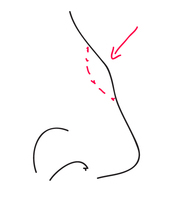
Humped nose (dorsal hump)
A bump of bone and cartilage on the bridge, visible in profile. It is removed and the bridge smoothed, either by conventional reduction or by preservation techniques that lower the bridge while keeping its natural lines. Read about humped nose surgery.
Droopy nose tip
A tip that points downward, often drooping further when smiling, which makes the nose look longer and older. Tip support is rebuilt and the tip rotated to a natural angle. See droopy nose tip surgery.
Big or long nose
A nose that is out of proportion with the face. Reduction is planned in all dimensions (length, projection, width) while keeping the nose natural. See big and long nose surgery.
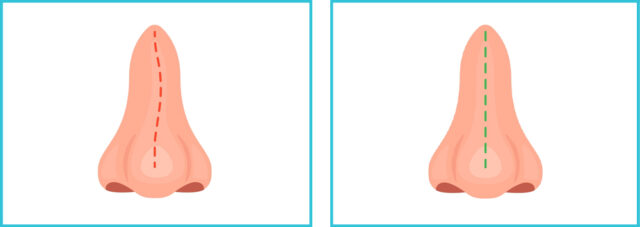
Crooked or S-shaped nose
A nose deviated to one side, or bent like a C or an S, usually with a deviated septum. It requires correction of the septum, bones and cartilage together. See crooked nose rhinoplasty.
Wide nose
A broad bridge, a wide tip or a wide base. Bones are narrowed with controlled osteotomies (ultrasonic piezo instruments reduce trauma), the tip is refined and the base narrowed where necessary.
Narrow or pinched nose
A nose that is too narrow, often after previous surgery, which may also block breathing. Spreader grafts and structural support widen the middle vault and open the airway.
Short or upturned nose
A nose that is too short or over-rotated, frequently a result of earlier surgery. Lengthening requires cartilage grafts to extend the septum and derotate the tip.
Parrot-beak (polly beak) and pointed noses
A fullness above the tip or an overly sharp, pinched tip. Both need precise balancing of the dorsum and tip framework.
Saddle nose (collapsed bridge)
A scooped or collapsed bridge caused by trauma, previous surgery or disease. The bridge is rebuilt with cartilage grafts. See saddle nose repair.
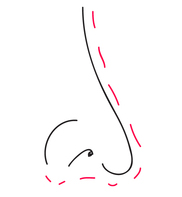
Large nostrils and wide nasal wings
Flared or oversized nostrils are reduced through small, hidden excisions at the base of the nose. See nostril and nasal wing reduction.
Asymmetric nose
Differences between the two sides of the nose, nostrils or tip are corrected with meticulous cartilage work and grafts.
Thin-skinned and thick-skinned noses
Thin skin reveals every detail of the framework, so smooth, camouflaged cartilage work is essential. Thick skin hides definition and swells longer, so a strong framework and specific aftercare are required. See rhinoplasty and skin type.
Ethnic noses
Middle Eastern, Asian, African and other ethnic noses have characteristic features that should be refined, not erased. See the ethnic rhinoplasty guide.
Functional rhinoplasty: breathing problems
Deviated septum: the wall dividing the nose is bent, blocking one or both sides. See deviated septum.
Nasal valve collapse: the side walls of the nose collapse during inspiration. See nasal valve collapse.
Enlarged turbinates: chronic swelling of the internal turbinates obstructs airflow. See turbinate hypertrophy.
Nasal polyps: benign growths from inflamed lining. See nasal polyps.
Septal perforation: a hole in the septum causing crusting, bleeding or whistling.
Problems after failed rhinoplasty: over-resection can collapse the valves and bridge years later. See revision rhinoplasty.
When cosmetic and functional problems coexist, both are corrected in one operation, a septorhinoplasty. Learn the differences in aesthetic and functional rhinoplasty.
Choosing the right technique
Closed (endonasal) rhinoplasty avoids an external scar and preserves tissue; open rhinoplasty gives direct access for complex structural work; preservation rhinoplasty keeps the natural dorsum. Prof. Dr. Tas selects the approach according to the nose type, and uses closed, atraumatic techniques whenever possible for less swelling and faster recovery. Read the complete rhinoplasty guide.
Frequently asked questions
Can more than one nose problem be fixed in one surgery?
Yes. Most patients have several issues, such as a hump, a droopy tip and a deviated septum, and all are corrected together.
Which nose type is the hardest to correct?
Thick-skinned noses, severely crooked or S-shaped noses and noses damaged by previous surgery are the most demanding.
Will my nose look natural?
The goal is a nose that suits your face and keeps your character; see what a natural nose should look like.
Next step
Send your photos for an online assessment or contact Prof. Dr. Suleyman Tas Clinic to find out which rhinoplasty plan suits your nose type.
About the author
Prof. Dr. Suleyman Tas is a European Board-certified plastic, reconstructive and aesthetic surgeon based in Istanbul with over 20 years of experience, author of Rhinoplasty in Practice (CRC Press) and founder of the Closed Atraumatic Rhinoplasty Course. Read verified patient reviews or book a consultation.
This article is for general information and does not replace an individual medical consultation.



Comments