_edited.png)

Ozempic Face: What Rapid Weight Loss Does and How It Is Treated
Quick answer. Ozempic face is a lay term for the hollow, deflated and prematurely aged appearance that can follow rapid weight loss on GLP-1 medication such as semaglutide or tirzepatide. The face loses fat that was providing structural support, and the skin envelope that used to be filled is suddenly too large for what is underneath. Treatment depends on which of the two dominates: lost volume is replaced, while a loose envelope has to be repositioned surgically.
Key takeaways
The face is not targeted by the drug. It simply loses fat along with the rest of the body.
Fat loss in the face is more visible than elsewhere because facial fat sits in discrete compartments.
Rapid loss gives the skin no time to retract, which is why the speed matters as much as the amount.
Volume loss alone is treated with fat grafting or filler.
Once the tissue has descended and the jawline has gone, only a lift restores it.
Why the face changes so visibly
Facial fat is not a single layer. It is organised into superficial and deep compartments that support the cheek, the temple and the area around the mouth. When those compartments shrink, the overlying skin and ligaments lose their scaffold. The temples hollow, the cheeks flatten, the area under the eye lengthens, the folds around the mouth deepen and the jawline softens as tissue slides downward.
Two things make this worse after GLP-1 weight loss than after slow dieting. The first is speed. Skin retracts over months, not weeks, and very rapid loss outpaces it. The second is that these medications frequently produce loss at an age when the skin has already lost collagen and elastin, so its ability to shrink back is limited.
Volume loss or descent: the distinction that decides treatment
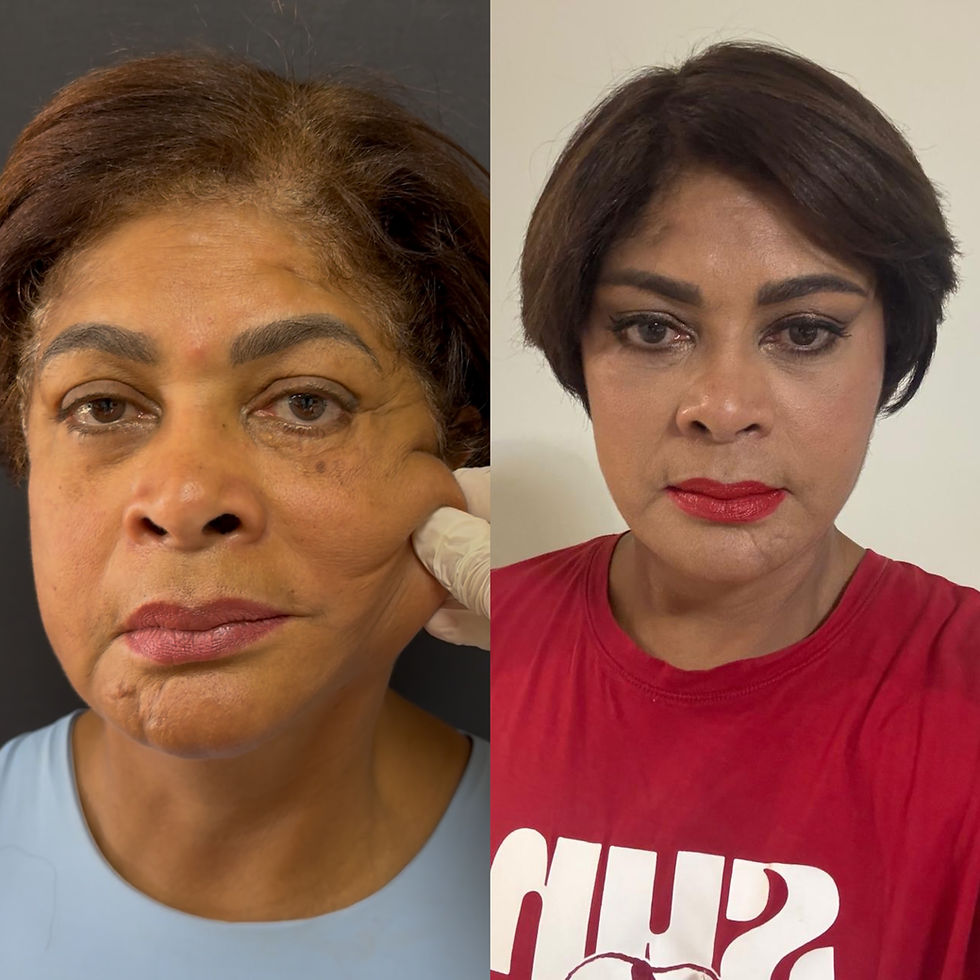
This is the single most useful thing to understand before spending money. Lift the skin of the upper cheek upward and outward with two fingers and watch what changes.
If the face looks restored mainly when you push volume in, for example when the temple or the front of the cheek fills out, the problem is volume.
If it looks restored when you lift tissue up, and a jawline reappears, the problem is descent.
Most patients after significant weight loss have some of both, and the proportion determines the plan.


What actually works
Fat grafting. Your own fat, harvested and transferred to the deep compartments, is the most natural way to restore lost facial volume, and it improves skin quality over time. A proportion is resorbed, so slight over correction and sometimes a second session are normal.
Dermal filler. Useful and immediate for moderate volume loss, particularly in the temple, mid cheek and tear trough. It is maintenance rather than restoration, and over filling a face that has descended makes it look heavier rather than younger.
Deep plane facelift with neck lift. When the jaw border has been lost and the neck has loosened, this is the only reliable answer. Lifting the deep layer restores the position of what remains, and fat grafting at the same time restores what was lost.
Skin quality treatments. Resurfacing, radiofrequency microneedling and medical skin care improve texture and crepiness but do not reposition tissue.
Timing: when should you have surgery?
Wait until your weight is stable. Operating during active weight loss means the face will continue to deflate afterwards and the result will change. Most surgeons ask for a stable weight for at least three to six months, and for patients to be honest about whether they intend to continue the medication, because stopping it often brings some weight back.
If you are still losing, the sensible interim steps are skin care, sun protection and, if you want it, modest filler that can be adjusted later.
Protecting your face while you lose weight
Lose more slowly where your clinician agrees that is safe.
Maintain adequate protein intake and resistance training, which preserves lean mass.
Protect the skin from sun throughout the period of loss.
Have photographs taken at the start, so that later decisions rest on evidence rather than memory.
The face after rapid weight loss is a volume problem and a support problem at the same time. Treating only one of the two is why so many patients feel that something was done but nothing changed.
Frequently asked questions
What is Ozempic face?
A lay term for the hollow, deflated and prematurely aged facial appearance that can follow rapid weight loss on GLP-1 medication. It is caused by loss of facial fat, not by an effect of the drug on the skin itself.
Does Ozempic face go away on its own?
Partially, if weight is regained, but that defeats the purpose of the treatment. If skin has stretched and tissue has descended, it does not reverse by itself.
Is filler or fat grafting better after weight loss?
Fat grafting is more natural and longer lasting for significant volume loss. Filler is faster, adjustable and better suited to moderate, localised loss.
Do I need a facelift after major weight loss?
Only if the jaw border and neck have been lost. If the face is simply deflated but still well supported, volume restoration alone may be enough.
When can I have surgery after GLP-1 weight loss?
Once weight has been stable for at least three to six months, and after discussing the medication itself with your prescribing doctor.
Can I have fat grafting if I have lost a lot of body fat?
Usually yes, since only a small volume is needed, but if donor sites are very depleted your surgeon may recommend filler instead.
Assessment after weight loss
Prof. Dr. Suleyman Tas is a double board certified plastic, reconstructive and aesthetic surgeon in Istanbul with over 20 years of experience and more than 10,000 operations. Faces after weight loss are assessed for volume and for descent separately, and the plan usually combines the two. You may also want to read about how long a facelift lasts, since weight stability is one of the factors that protects the result.
Continue reading in this facelift series
See Prof. Dr. Suleyman Tas's Viral Before and After Results


Before you decide anything, spend a few minutes with the real cases and the real voices. Every photograph below belongs to a patient of Prof. Dr. Suleyman Tas, published with consent, and every review is signed by the person who wrote it.
400 verified patient reviews, with photographs and video testimonials — read what patients say in their own words.
Deep plane facelift and neck lift before and after gallery — the face and neck lift results that made the practice known, case by case.
Happy patient, happy doctor — photographs taken with patients on the day they went home.
Would You Like the Same Result?
If you are considering facial surgery yourself, the next step is a personal assessment. Prof. Dr. Suleyman Tas reviews your photographs, explains which technique suits your anatomy, and tells you honestly whether surgery is the right answer for you at this stage.
Create your consultation with Prof. Dr. Suleyman Tas — Prof. Dr. Suleyman Tas Clinic, Terrace Fulya, Sisli, Istanbul.

Comments