

Deep Plane Facelift in Istanbul: Natural, Long-Lasting Results
Updated: Oct 25

Facial Rejuvenation with Prof. Dr. Suleyman Tas
Prof. Dr. Suleyman Tas is one of Istanbul’s most experienced facelift surgeons. Patients come to him for a youthful, natural look with innovative techniques, VIP care, and world-class expertise.
Why Patients Choose Prof. Dr. Süleyman Taş for a Facelift
Patients researching facelift surgery in Istanbul quickly come across one name: Prof. Dr. Suleyman Tas. Known internationally for his artistry, precision, and natural results, Prof. Dr. Taş combines advanced surgical techniques with a deep understanding of facial aesthetics.
Over 50 international scientific publications in plastic surgery
Author of specialized surgical books used worldwide
Pioneer of advanced SMAS & deep-plane facelift techniques
Global recognition as a trainer and keynote speaker at international congresses
His approach focuses on restoring youthful contours while preserving your natural expressions. This ensures you look refreshed – never artificial.
What is a deep plane facelift?
A deep plane facelift lifts the face below the SMAS, the muscular layer under the skin, and releases the retaining ligaments that hold the cheek and midface down. Skin and deeper layer move together as one unit, so there is no tension on the skin, the expression stays natural and the correction usually lasts longer than a skin-only lift.
The plane is chosen for the anatomy, not as a label. A SMAS lift, a deep plane lift or a limited (mini) lift may each be the right answer depending on how much sagging there is, the condition of the neck, skin quality and age. In the consultation Prof. Dr. Tas explains which technique he plans to use and why.
How a deep plane facelift differs from a SMAS facelift
Both operations work on the SMAS, the fibrous muscular layer under the skin of the cheek and jaw. The difference is what is done with it. In a SMAS facelift the layer is tightened from the surface, by folding it or removing a strip and suturing the edges, while the skin is lifted separately above it. In a deep plane facelift the surgeon enters beneath the SMAS, releases the four or five retaining ligaments that pin the cheek and jowl to the bone, and moves skin and SMAS together as a single, well-vascularised flap.
Three things follow from that. The mid face, which a SMAS lift barely reaches, is repositioned rather than pulled. The skin carries no tension of its own, so incisions heal finer and the risk of the tight, wind-swept look is far lower. And because the tissue is released rather than stretched, the lift is expected to hold longer. The cost is a longer operation that demands direct visualisation of the facial nerve branches, which is why it should be performed by a surgeon who does it routinely.
What a deep plane facelift improves, and what it does not
Jowls and the jawline. The most reliable change: a clean line from chin to ear once the descended cheek fat is returned to its original position.
Nasolabial folds and the mid cheek. Softened by repositioning the malar fat pad, not by filling the fold.
Marionette lines and the corners of the mouth. Improved as the jowl is lifted away from them.
The neck, when a neck lift is performed at the same time, which for most patients over fifty it should be. The deep plane neck lift is explained here.
Not improved: fine lines and sun damage on the skin surface, hollow temples or under-eye hollows (fat transfer), heavy upper eyelids (blepharoplasty) or a low brow (endoscopic brow lift). These are added when they are the problem, not assumed.
Who is suitable for a deep plane facelift
The typical patient is in the mid forties to the seventies, with visible descent of the cheek, jowls that blur the jawline and a neck that has started to loosen. Skin quality matters less than with older techniques, because the skin is not the load-bearing layer. Patients who have had a previous facelift that has relapsed are often good candidates for a deep plane revision. Those with early jowling and a firm neck may be better served by a smaller operation; how a mini facelift compares is covered here. Nicotine use, uncontrolled blood pressure and unstable weight are reasons to wait, and are discussed at the first consultation.


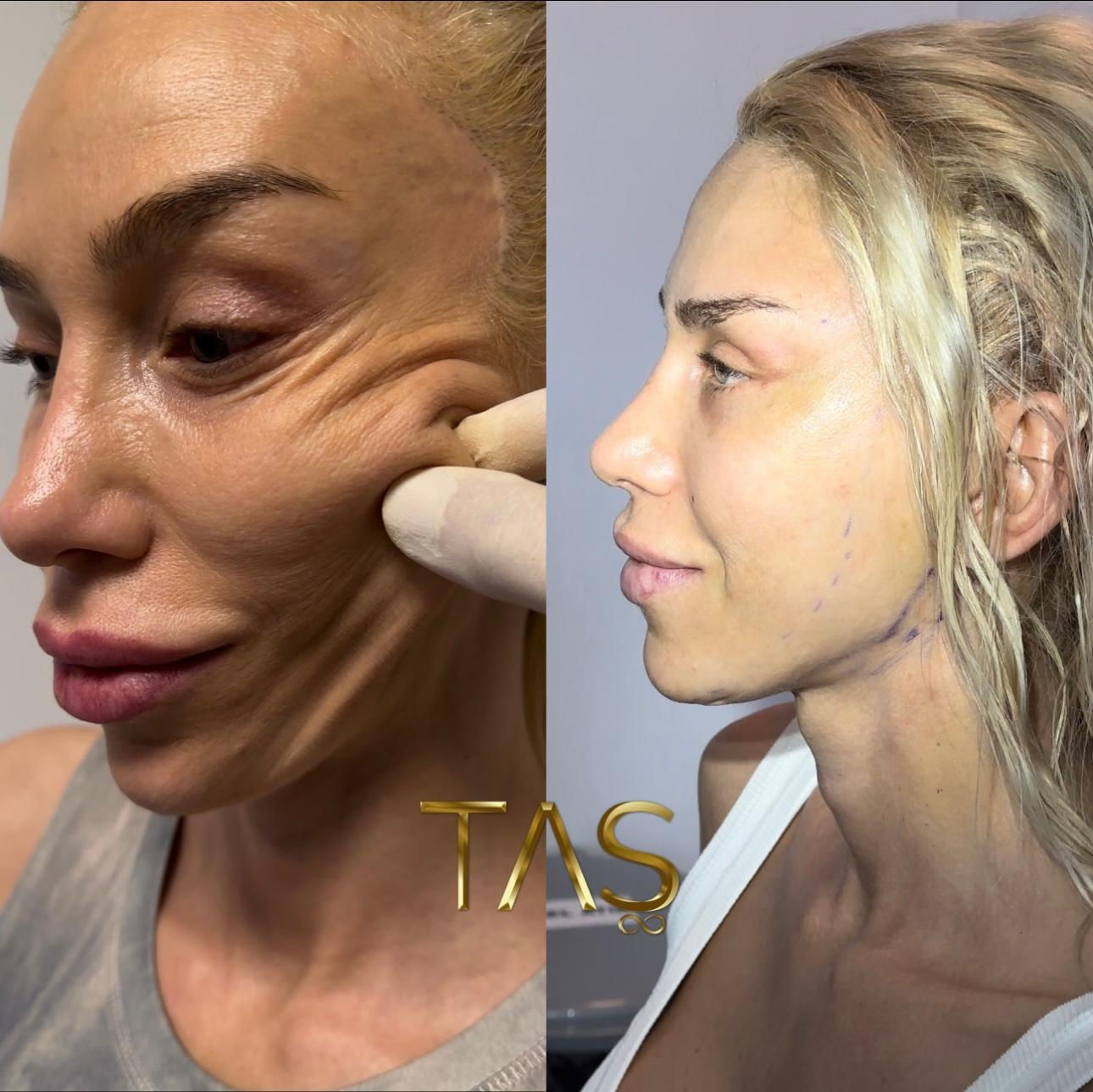
How the operation is performed
Assessment and planning
Prof. Dr. Suleyman Tas examines the face in motion and at rest, assesses the position of the cheek fat, the depth of the jowl, the platysma bands and the skin of the neck, and reviews photographs from ten and twenty years earlier when the patient has them. The plan states which areas will be lifted, whether the neck will be opened, and which additional procedures, if any, are recommended.
Anaesthesia
The operation is performed under local anaesthesia, without general anaesthesia, in the operating theatre of Prof. Dr. Tas's licensed clinic in Terrace Fulya. It takes six to eight hours when the neck and other areas are included, and patients go to their hotel the same day with a private nurse.
Incisions
The incision begins in the hair at the temple, follows the natural crease in front of the ear and passes behind the small cartilage at the ear opening so that the visible part is minimal, continues around the earlobe and behind the ear, and ends in the hair at the back of the neck. When the neck is treated, a short incision under the chin allows the platysma muscles to be repaired. Where the incisions go and how the scars mature is described in detail here.
Release and repositioning
The surgeon lifts the skin only as far as the front edge of the SMAS, then enters the deep plane and releases the retaining ligaments of the cheek and jaw under direct vision. The whole composite flap of skin and SMAS is moved upward and slightly backward along the axis of the original descent, and fixed to firm structures near the ear. In the neck, the platysma is tightened and, where needed, the deep fat and the glands that push the neck forward are reduced.
Closure
Only the excess skin that now hangs free is removed; the skin is closed without tension. No drain is used, and a soft dressing is applied.
Recovery week by week
The first 48 hours
You go to your hotel the same day with your private nurse. Swelling and some bruising are expected and peak at around seventy two hours. Pain is usually described as tightness rather than sharp pain and is controlled with simple analgesics. The dressing is changed the next day.
The first week
Sleep with the head elevated, keep the head still, eat soft food and walk short distances indoors. Sutures in front of the ear are removed at around day five to seven. By the end of the first week most patients are comfortable in the hotel and able to walk in the city with a hat and sunglasses.
The second week
Remaining sutures come out. Bruising fades to yellow and can be covered. Most patients fly home between day ten and day fourteen, after the final in-person review. How long to stay in Istanbul and when it is safe to fly has the day-by-day plan.
Weeks three to six
Return to desk work is usual in the third week, and social events without explanation by the fourth. Light exercise resumes from week three, heavier training from week six. Numbness of the cheeks and around the ears is normal and fades gradually.
Three months and beyond
Residual swelling, particularly at the sides of the neck and in front of the ears, settles over three to six months. The scars are pink at three months and pale and flat by one year. What is normal and what is not in swelling and bruising and how to speed up recovery are covered in their own guides.
When the result is visible and how long it lasts
The new jawline and cheek position are visible as soon as the early swelling subsides, in the second and third weeks; the refined result is judged at three to six months and the scars at one year. Because the deep layer has been released and repositioned rather than stretched, the improvement is durable: the face continues to age from a younger starting point, and most patients do not consider further surgery for a decade or more. What the face looks like five and ten years after a facelift is discussed separately.
Will it look natural?
The unnatural facelift, the flattened cheek, the pulled mouth and the ear that looks tugged, is a product of tension on the skin. A deep plane facelift places the tension in the deep layer and moves tissue back along the path it descended, so the face keeps its proportions and its expression. The aim is to look rested and well, not different.
Risks
Bleeding under the skin in the first day, temporary weakness of a facial nerve branch, numbness, infection, visible scarring and asymmetry are the recognised risks. They are uncommon in experienced hands and are managed by careful blood pressure control, direct visualisation of the nerve branches during surgery, a private nurse on the first night and a stay in Istanbul long enough for early problems to be seen and treated. The risks and complications of deep plane facelift surgery are set out honestly here.
Deep Plane, SMAS, Endoscopic and Mini Facelift: Which Technique Suits Which Face?
There is no single best facelift technique, only the technique that fits a particular face, skin quality and goal. The main options compare as follows.
Deep plane facelift: releases the retaining ligaments and repositions the cheek fat, SMAS and platysma as one composite layer. It is typically considered when the midface, jowls and neck all need to move together.
SMAS facelift (plication, SMASectomy or SMAS flap): tightens or repositions the SMAS layer without releasing the deeper ligaments. It suits moderate laxity and moves the midface less.
Endoscopic facelift: uses small incisions and an endoscope, mainly to lift the brow and upper midface in patients with little excess skin. It does not remove significant loose skin from the lower face or neck.
Mini facelift (short-scar): shorter incisions and a limited lift for early jowling. The change is smaller and may not last as long as with a more extensive operation.
Prof. Dr. Suleyman Tas chooses between these after examining your face and discussing your goals. Read more in the guides to endoscopic facelift and scarless facelift.
Deep Plane Facelift for Men
Men can have an excellent deep plane facelift, but the operation is planned differently. Beard-bearing skin and sideburns move when the face is lifted, so the incisions and the direction of the lift must keep hair-bearing skin in a natural position and avoid pulling beard growth towards the ear. The male face usually has thicker, more vascular skin, and men have a higher reported risk of hematoma after a facelift, so blood pressure control and careful bleeding control matter. Most men also want a result that looks rested rather than operated on, which suits a repositioning technique.
Revision and Secondary Facelift
Patients who have already had a facelift can sometimes have a secondary deep plane facelift, but scar tissue from the first operation changes the anatomy and the risk. Ask how many revision facelifts the surgeon performs, request photographs of earlier revision patients, and bring the operative report from the first surgery if you have it. For a checklist of questions, see How to choose the best facelift surgeon.
Why Patients Travel to Istanbul for Facelift Surgery
Istanbul has become a global hub for medical tourism, attracting patients from Europe, the USA, the Middle East, and Asia. Choosing Istanbul for facelift surgery means:
Access to world-class surgeons like Prof. Dr. Süleyman Taş
Affordable luxury compared to Western countries
VIP medical tourism packages including accommodation, transfers, and post-op care
A city rich in culture, making recovery a pleasant and memorable experience
The Facelift Process Step by Step
1. Initial Consultation – Detailed 3D facial analysis & customized treatment plan.
2. Surgery Day – Performed in a state-of-the-art hospital with advanced anesthesia techniques.
3. Recovery Protocols – Specialized care to minimize swelling and speed healing.
4. Follow-Up & Maintenance – Post-op check-ups and skincare programs for lasting results.
Advantages of a Facelift with Prof. Dr. Suleyman Tas
Patients who choose Prof. Dr. Tas for a facelift with Prof. Dr. Tas benefit from:
Natural, age-defying results tailored to facial structure
Invisible scars hidden along natural folds
Quick return to social life due to advanced surgical methods
Comprehensive aftercare by a multilingual medical team
VIP patient experience with 5-star accommodation & private nurse assistance
International Recognition & Awards
Prof. Dr. Suleyman Tas has performed live facelift surgeries in cities like London, Dubai, Milan, and New York. He showcases his skill to fellow surgeons. His techniques have been featured in global medical journals, and he regularly teaches these techniques to other surgeons.
Before and After: What a Natural Result Looks Like
Patients often say their transformation with Prof. Dr. Taş is subtle yet remarkable. This is the hallmark of a true facelift expert – a natural rejuvenation that enhances, not changes, who you are.
Book Your Facelift Consultation in Istanbul
If you are ready to reverse the signs of aging and restore your youthful glow, book your consultation with Prof. Dr. Suleyman Tas today.
Understanding the Importance of Choosing the Right Surgeon
Choosing the right surgeon is crucial for achieving the desired results. A skilled surgeon can make all the difference in your facelift experience. Here are some factors to consider:
Experience and Credentials: Look for a surgeon with extensive experience in facelift procedures. Check their credentials and any certifications they may have.
Patient Reviews: Read reviews from previous patients. Their experiences can provide insight into the surgeon's skills and patient care.
Consultation: Schedule a consultation to discuss your goals and concerns. This is an opportunity to gauge the surgeon's approach and expertise.
The Emotional Aspect of Facelift Surgery
Undergoing facelift surgery is not just a physical transformation; it can also have emotional benefits. Many patients report increased confidence and self-esteem after their procedures. Here’s how:
Boosted Confidence: A youthful appearance can lead to a more positive self-image.
Improved Social Interactions: Feeling good about your appearance can enhance your interactions with others.
Long-Term Satisfaction: Many patients find that the results of their facelift lead to lasting happiness and contentment.
Frequently asked questions
Am I a good candidate for a facelift?
Typically patients from their forties to their seventies who have sagging in the cheeks, jawline or neck and reasonable skin quality. Smoking, uncontrolled blood pressure or diabetes are managed first, and realistic expectations matter more than the number in your passport.
Where are the scars after a facelift?
The incisions follow the natural creases in front of and behind the ear and continue inside the hairline. They are placed so that hair and make-up cover them while they fade over the following months.
How long does a deep plane facelift last?
Most patients keep the improvement for roughly a decade, because the lift is carried by the deeper layer rather than by the skin. Ageing continues, so sun protection, skin care and non-surgical maintenance still matter.
Can a facelift be combined with other procedures?
Yes. Eyelid surgery, brow lift, fat grafting, a neck lift or rhinoplasty are often performed in the same session so that the face stays in balance and the total recovery is shorter.
How long should international patients stay in Istanbul?
Plan ten to fourteen days, so that dressings and sutures can be checked and removed and the first swelling has settled before you fly home. Swelling and bruising are most visible in the first ten days, and most patients feel comfortable in public after two to three weeks.
How much does a facelift in Istanbul cost?
The price depends on the technique, on whether a neck lift or eyelid surgery is added, and on the hospital and anaesthesia used, so it is given as a personal quotation after examination rather than as a fixed list price.
Is a deep plane facelift permanent?
No facelift stops aging. A deep plane facelift resets the position of the deep tissues, and the face then ages from that younger baseline. Most patients keep a clear improvement for ten years or more; some choose a smaller secondary procedure later.
Does a deep plane facelift include a neck lift?
Not automatically. The face and the neck are treated through connected incisions, and for most patients over fifty they are treated together in the same operation, but the neck component is planned and quoted explicitly.
When can I return to work after a deep plane facelift?
Desk work from around the third week, when swelling and bruising are no longer obvious. Physically demanding work from week six.
How is a deep plane facelift different from a ponytail lift?
A ponytail lift is a marketing name for a limited procedure through small incisions in the hairline that lifts the upper face and temple. It does not treat the jowl or the neck. The two are compared here.
Is a deep plane facelift better than a SMAS facelift?
Neither is better for everyone. A deep plane facelift moves the midface, jowls and neck more as one unit and is considered for more advanced laxity, while a SMAS facelift suits milder laxity. The surgeon’s experience with the chosen technique matters as much as the technique itself.
Can men have a deep plane facelift?
Yes. The operation is planned differently in men because of beard-bearing skin, sideburns, thicker skin and a higher reported hematoma risk, so ask the surgeon how these points are managed.
Can I have a deep plane facelift if I had a facelift before?
Often yes, but a secondary facelift is more complex because of scar tissue from the first operation. Choose a surgeon who performs revision facelifts regularly and bring your earlier operative report if you have it.
Conclusion: Your Journey to a New You
In conclusion, choosing Prof. Dr. Süleyman Taş for your facelift in Istanbul means opting for expertise, care, and a commitment to natural results. With his advanced techniques and personalized approach, you can embark on a journey to a rejuvenated appearance. Don’t wait any longer; take the first step towards a more youthful you today.
Prof. Dr. Suleyman Tas Clinic — Terrace Fulya Center, Teşvikiye, Hakkı Yeten Cd. No:11 D:1, Daire:97, 34349 Şişli / İstanbul, Türkiye. Telephone: +90 543 456 36 93. Request an appointment.
Related reading
About the author
Prof. Dr. Suleyman Tas is a European Board-certified plastic, reconstructive and aesthetic surgeon based in Istanbul with over 20 years of experience, author of Rhinoplasty in Practice (CRC Press) and founder of the Closed Atraumatic Rhinoplasty Course. Read verified patient reviews or book a consultation.
This article is for general information and does not replace an individual medical consultation.
More Facelift Guides From Prof. Dr. Suleyman Tas
See Also on drsuleymantas.com
Core Facelift Guides From Prof. Dr. Suleyman Tas
Facelift in Istanbul — Prof. Dr. Suleyman Tas’s main facelift page: techniques, results and how to book a consultation.
Facelift in Turkey — safety, travel planning and aftercare for international patients.
Endoscopic facelift — the minimally invasive option for the upper and mid face.
Scarless facelift in Istanbul, Turkey — how a no-visible-scar approach works and who qualifies.
How to choose the best facelift surgeon — six checks to make before you book.
Deep plane facelift in Istanbul — the dedicated page: what a deep plane facelift is, candidates, how it is performed, recovery, how long it lasts and what the cost depends on.
Facelift cost in Turkey — what the cost depends on and a comparison with US and UK prices.


Comments