

How to Choose a Facelift Surgeon: 6 Things to Check
Updated: Oct 25
A facelift is one of the more technically nuanced procedures in facial plastic surgery — the difference between a surgeon who's good and one who's exceptional often shows up as the difference between a result that looks "done" and one that simply looks like a more rested, youthful version of the same face. Here's what to actually evaluate.
A facelift result that reads as a naturally rested, refreshed face — the hallmark of a well-executed structural lift rather than simple skin tightening.
1. Board Certification in Plastic Surgery
As with any surgical procedure, confirm your surgeon holds recognized plastic surgery board certification (in Europe, look for European Board of Plastic, Reconstructive and Aesthetic Surgery credentials). This confirms standardized surgical training and ongoing professional accountability.
2. A Track Record Specifically in Facial Rejuvenation
General plastic surgery experience doesn't automatically translate to facelift expertise — facial anatomy, nerve mapping, and tissue-lifting technique are a distinct skill set. Ask specifically:
How many facelifts has this surgeon performed?
Do they perform SMAS-layer facelifts (structural repositioning), or primarily skin-only tightening? (The former typically produces more natural, longer-lasting results.)
What's their approach to scar placement and minimization?
3. A Portfolio That Shows Natural-Looking Results — Not an Overly "Pulled" Look
The clearest marker of facelift skill isn't dramatic transformation photos — it's results that look rested and refreshed rather than visibly altered. Ask to see a range of results, ideally at both early recovery and long-term follow-up (one year or more), since a facelift that looks great at 3 weeks but has "relaxed" oddly by year one indicates a problem with the underlying technique, not just healing time.
4. A Consultation That Discusses the Full Picture, Not Just Skin
A facelift addresses tissue laxity — but a surgeon who only talks about tightening skin, without discussing volume loss, neck laxity, or how your nose and mid-face interact with the rest of your results, may be underselling what a complete facial rejuvenation plan should include. A thorough consultation should cover:
Whether a neck lift should be combined, given your specific anatomy.
Whether fat grafting is recommended to restore volume the lift itself won't add.
Whether eyelid, brow, or lip surgery is relevant to your overall goals.
A clear, honest answer about incision placement and expected scar visibility.
5. Transparency About Recovery and Combined Procedures
Ask directly how many procedures they'd recommend combining into a single operation, and why. A surgeon who's willing to say "we should stage this instead of combining it all at once because it'll heal better" is prioritizing your outcome over convenience or cost — and that's a meaningful signal about how they'll handle decisions throughout your entire treatment plan.
6. Communication and Aftercare Structure
Ask what your specific follow-up schedule looks like — when sutures come out, when swelling is expected to resolve, and how many post-operative visits are included. A well-structured aftercare plan is one of the clearest indicators of a practice built around long-term patient outcomes, not just the surgery date itself.
How to Verify a Facelift Specialist in Istanbul or Turkey
Anyone can call themselves a facelift specialist online. In Turkey, as in most countries, the phrase is a marketing description, not a licence. These checks separate a verifiable specialist from a polished advertisement.
Training and certification: confirm that the surgeon completed a recognised plastic, reconstructive and aesthetic surgery residency, and ask which board or national body certified them. In Europe, the European Board of Plastic, Reconstructive and Aesthetic Surgery (EBOPRAS) awards a diploma to qualified plastic surgeons; the credential is written FEBOPRAS.
Professional societies: look for the surgeon in the member directory of the Turkish Society of Plastic, Reconstructive and Aesthetic Surgeons (TPCD) and, where a surgeon claims it, in the ISAPS "Find a Surgeon" directory of the International Society of Aesthetic Plastic Surgery. A claimed membership should be easy to confirm in the official list.
Personal facelift volume: ask how many facelifts the surgeon performs personally each year and which techniques (deep plane, SMAS, endoscopic, short-incision) are used. A specialist answers with numbers and explains why one technique suits your face better than another.
Taught and published work: conference faculty roles, peer-reviewed publications and teaching positions show that other surgeons trust the technique enough to learn from it.
The hospital: confirm that the operation takes place in a hospital licensed by the Turkish Ministry of Health, with an anaesthesiologist and intensive-care backup, not in an office procedure room.
The operating surgeon: ask for written confirmation that the surgeon you meet at the consultation is the surgeon who performs the operation.
Facelift Specialist or General Plastic Surgeon?
Facelift surgery is part of plastic surgery, and surgeons differ widely in how much of their practice it makes up. A surgeon who divides time between breast, body and nose surgery can still deliver an excellent facelift, but a deep plane or revision facelift rewards a surgeon who performs these operations regularly. A practical way to decide: ask what share of the practice is facial rejuvenation, ask to see consecutive patients rather than only selected best cases, and ask how complications such as hematoma, skin-flap problems or temporary facial nerve weakness are prevented and managed. A trustworthy surgeon discusses these openly and gives you realistic ranges instead of promises.
Questions Specific to Deep Plane Facelift
The deep plane technique releases and repositions the facial soft tissues, including the SMAS (superficial musculoaponeurotic system), as one layer instead of tightening the skin alone. Because the dissection runs close to the branches of the facial nerve, it is an operation to entrust to a surgeon with specific, documented experience.
How many deep plane facelifts have you performed, and how many in the last year?
How do you protect the facial nerve branches, and what happens if a temporary weakness occurs?
How do you treat the neck and jawline in the same operation?
Can I see deep plane results at one year and beyond, in patients of my age and skin type?
What would you do differently in a revision facelift after a previous operation?
How do you place the incisions, and how do you protect the hairline and the area around the ear?
Read the full technique guide: Deep plane facelift in Istanbul.
Extra Checks for International Patients Considering a Facelift in Turkey
A written quotation that lists what is included: surgeon’s fee, hospital, anaesthesia, medication, accommodation, transfers and follow-up appointments.
A stay in Istanbul long enough for the first check-up: ask the surgeon how long they recommend, and be cautious about itineraries that send you home earlier.
A named contact for aftercare once you are home, and a clear written policy on how complications and revisions are handled.
Copies of the operative report and your photographs, so your doctor at home can continue your care.
Direct communication with the surgeon before you travel, not only with a patient coordinator.
The surgeon’s advice on flight timing and blood clot prevention after surgery.
More detail on safety, travel and aftercare: Facelift in Turkey for international patients. For pricing, see Facelift cost in Istanbul.
How Prof. Dr. Suleyman Tas Approaches Facelift
Prof. Dr. Suleyman Tas is a plastic surgeon in Istanbul who holds the European Board qualification (FEBOPRAS), has more than 20 years of surgical experience, and teaches deep plane facelift and rhinoplasty to surgeons in international live-surgery courses. The facelift technique — deep plane, endoscopic or a shorter-incision approach — is chosen after examining your face, not before.
You can review the details on the Facelift in Istanbul page, in the guides to deep plane facelift, endoscopic facelift and scarless facelift, and meet the surgeon on the About Me page.
Who Is the Best Facelift Surgeon in Istanbul?
No independent ranking can name one best facelift surgeon, and any website that claims to is selling something. The best surgeon for you is the one whose verifiable training, personal facelift volume, long-term results and communication fit your needs. Use the checks above to compare Prof. Dr. Suleyman Tas and any other surgeon on the same terms, then book a consultation and judge the answers you receive.
Questions to Bring to Your Consultation
Do you perform SMAS-layer facelifts, and what's your approach to scar placement?
Should I combine a neck lift, fat grafting, or eyelid surgery with my facelift?
Can I see results from patients with a similar starting point to mine, both early and at one year or more?
What does my specific recovery and follow-up schedule look like?
Red Flags to Watch For
A consultation that's entirely about skin tightening with no discussion of the deeper SMAS layer.
Pressure to combine an unusually large number of major procedures into a single operation.
No willingness to show longer-term (one year+) results, only early post-op photos.
Vague or evasive answers about incision placement and expected scarring.
FAQ
Is a "scarless" facelift really scarless?
No facelift is truly scarless — minimal-incision techniques place scars carefully within natural creases and the hairline to make them as inconspicuous as possible, not invisible.
Should I get a facelift and rhinoplasty at the same time?
Sometimes — particularly in patients over 45, where mid-face sagging affects the area around the nose. Ask your surgeon whether combining them makes sense for your specific case; see our post on combining rhinoplasty and facelift.
How do I know if a facelift result will look natural?
Ask to see the surgeon's longer-term results (one year or more) rather than just early post-op photos — a technique that produces a natural, lasting result should hold up well over time, not just in the first weeks.
Is Istanbul a good destination for facelift surgery?
Istanbul has become one of the world's major hubs for facial plastic surgery, with a high concentration of specialized surgeons and clinics experienced in treating international patients — but the same credential-vetting principles apply wherever you're considering surgery.
How can I verify a facelift specialist in Istanbul?
Ask for the surgeon’s board certification and professional society membership and confirm them in the official directories, ask for personal facelift case numbers and long-term results, and confirm that the operation takes place in a licensed hospital and is performed by the surgeon who consulted you.
Who is the best facelift surgeon in Istanbul?
No independent ranking can name a single best surgeon. Compare verifiable training, personal facelift volume, results at one year and beyond, and aftercare, then choose the surgeon whose answers and results fit your needs.
What should I ask a deep plane facelift surgeon?
Ask how many deep plane facelifts they have performed personally, how they protect the facial nerve branches, how they treat the neck and jawline, and whether they can show results at one year or more in patients like you.
Is a facelift in Turkey safe for international patients?
It can be when you choose a qualified plastic surgeon, a licensed hospital, a written aftercare plan and enough time in Istanbul for follow-up. Safety depends on those choices more than on the country.
Next Step
If you're ready for a thorough, honest facelift consultation — covering skin, structure, volume, and your full facial rejuvenation goals — book a consultation with Prof. Dr. Suleyman Tas.
Continue reading: The Complete Guide to Facelift Surgery · Combining Rhinoplasty, Facelift & Facial Contouring · Meet Prof. Dr. Suleyman Tas

Choosing a facelift surgeon is a bigger decision than a single before-and-after photo. Here's what actually predicts a natural, long-lasting result.
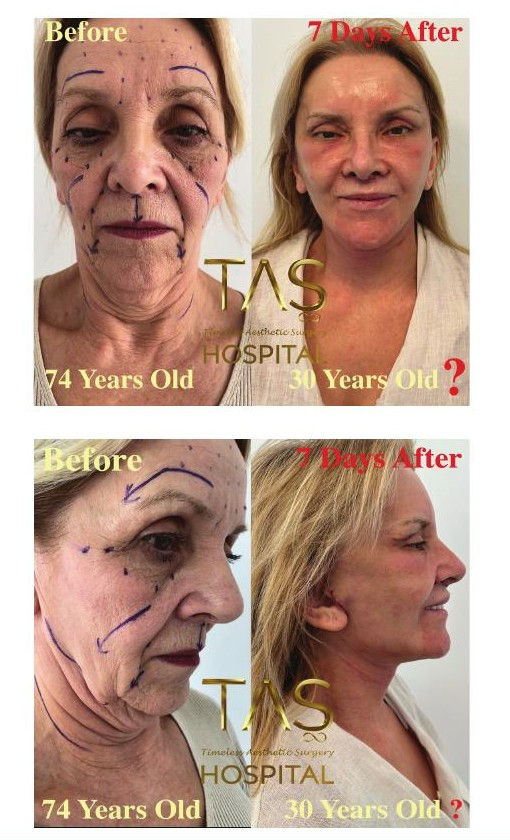
A facelift is one of the more technically nuanced procedures in facial plastic surgery — the difference between a surgeon who's good and one who's exceptional often shows up as the difference between a result that looks "done" and one that simply looks like a more rested, youthful version of the same face. Here's what to actually evaluate.
Related reading
About the author
Prof. Dr. Suleyman Tas is a European Board-certified plastic, reconstructive and aesthetic surgeon based in Istanbul with over 20 years of experience, author of Rhinoplasty in Practice (CRC Press) and founder of the Closed Atraumatic Rhinoplasty Course. Read verified patient reviews or book a consultation.
This article is for general information and does not replace an individual medical consultation.
More Facelift Guides From Prof. Dr. Suleyman Tas
Core Facelift Guides From Prof. Dr. Suleyman Tas
Facelift in Istanbul — Prof. Dr. Suleyman Tas’s main facelift page: techniques, results and how to book a consultation.
Deep plane facelift in Istanbul — how the deep plane technique works, who it suits and what recovery looks like.
Facelift cost in Istanbul — what the quotation includes and what affects the price.
Endoscopic facelift — the minimally invasive option for the upper and mid face.
Scarless facelift in Istanbul, Turkey — how a no-visible-scar approach works and who qualifies.
Deep plane facelift in Istanbul — the dedicated page: what a deep plane facelift is, candidates, how it is performed, recovery, how long it lasts and what the cost depends on.
Facelift cost in Turkey 2026 — what the cost depends on and a comparison with US and UK prices.


Comments