_edited.png)

Combining Rhinoplasty & Facelift for Total Facial Harmony
Updated: 5 hours ago
The nose doesn't exist in isolation — it's read by the eye in relation to the forehead, chin, lips, and cheeks around it. This is why many of the most satisfying facial rejuvenation results come not from a single isolated procedure, but from a plan that considers the whole face at once. Here's how surgeons think about combining procedures, and when it makes sense for you.
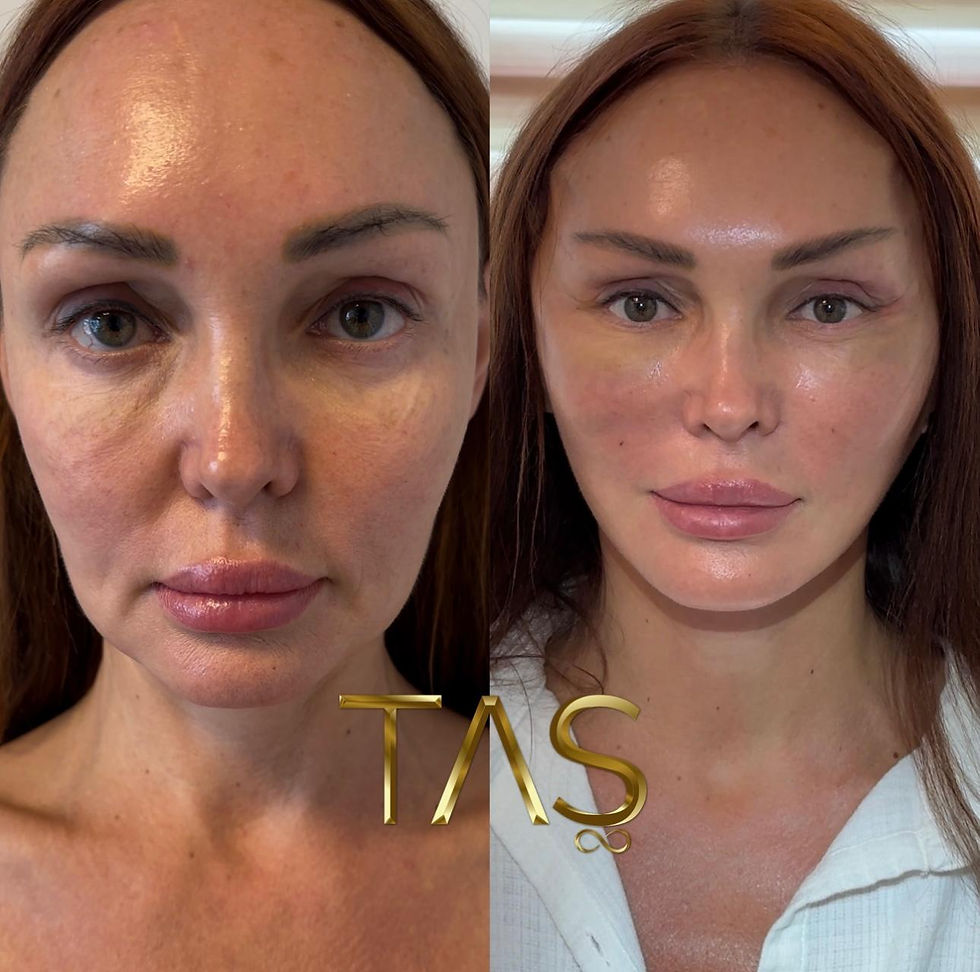
This 74-year-old patient's plan combined a facelift, neck lift, upper eyelid surgery, brow and temporal lift, lip lift, under-eye filler, nano-fat injection, and laser skin treatment — an example of whole-face planning rather than a single isolated procedure.
Why the Nose Can't Be Planned in Isolation
Human perception of size and proportion is relative, not absolute — we judge whether a nose looks "big" or "small" partly by comparing it to what's next to it. A patient with a strong nose complaint but a recessed chin illustrates this clearly: no matter how much the nose is reduced, it will continue to look disproportionately large relative to a chin that hasn't been addressed, because the relationship between the two features is what the eye actually perceives. This is the logic behind profiloplasty — a facial balancing approach that evaluates the nose in relation to the chin, forehead, and lips together, rather than planning nasal surgery as an isolated decision.
Why Facelift and Rhinoplasty Are Often Combined
Facial sagging with age concentrates heavily around the mid-face — directly around the nose. This creates two compounding effects: it makes precise nasal reshaping more difficult to achieve and to see clearly, and it means an excellent rhinoplasty result can still look incomplete if it sits within an otherwise aged, sagging mid-face. In patients over roughly 45 considering rhinoplasty, a combined face-and-neck lift is one of the most common recommendations, for exactly this reason — not simply for scheduling efficiency, but because it makes both individual results better than either would be alone.
A combined face and neck lift — commonly paired with rhinoplasty in patients over 45, since mid-face sagging directly affects how nasal surgery reads on the finished face.
The "1 + 1 = 3" Effect
Surgeons who take a whole-face approach often describe combining complementary procedures as producing a result greater than the sum of its parts. A nose refined in isolation looks like a nose. A nose refined alongside jawline definition, appropriate facial volume, and reduced skin laxity looks like a genuinely more youthful, harmonious face — which is usually the outcome patients are actually hoping for, even when the initial request was narrowly about the nose.
Commonly Combined Procedure Sets
Rhinoplasty + face and neck lift: addresses both the nasal structure and surrounding mid-face laxity together.
Rhinoplasty + fat injection: restoring volume to the cheeks, temples, or chin alongside nasal reshaping, to balance overall facial proportion.
Rhinoplasty + upper eyelid surgery: relatively low additional surgical burden, frequently combined for patients addressing multiple areas at once.
Rhinoplasty + chin augmentation: directly addressing the nose-chin proportion described above, sometimes tested first with temporary filler to confirm the patient likes the new balance before committing surgically.
Rhinoplasty + lip enhancement or lip lift: fat injection, filler, or a surgical lip lift used to balance lip volume and upper-lip proportion against a newly reshaped nose and profile.
Facelift + brow/temporal lift + upper eyelid surgery: addressing the upper and lower face together so the eyes and jawline read as a consistent, unified age.
The Limit: Your Body's Healing Capacity Is Finite
This is worth repeating because it's the most commonly overlooked factor in combined-procedure planning: your body has a finite wound-healing capacity at any given time. Minor procedures (fat injection, filler, laser treatments) add relatively little burden and combine easily with a major surgery. But stacking multiple major surgeries into a single operation — for example, a full facelift and an extensive body-contouring procedure on the same day — divides your body's healing resources across more sites, and each site heals more slowly as a result. An experienced surgeon prioritizes safety and healing quality over the convenience of doing everything in one sitting, and will tell you directly when something should be staged into a separate procedure instead.
How to Know If a Combined Approach Is Right for You
Ask your surgeon these questions during consultation:
Beyond my primary concern, are there other areas that would meaningfully change how my main result looks?
Would combining procedures achieve a materially better outcome, or is it mainly a scheduling convenience?
Given my health and the procedures being discussed, is this a safe combination, or should anything be staged separately?
What does recovery look like when these specific procedures are combined, versus done individually?
FAQ
Does combining procedures increase risk?
Combining a major procedure with minor complementary treatments (filler, fat injection, laser) generally doesn't meaningfully increase risk. Combining multiple major surgeries at once can increase healing time and risk, and should be evaluated case-by-case with your surgeon.
Is profiloplasty a single surgery?
No — profiloplasty is a planning philosophy that looks at the nose, chin, forehead, and lips together, not a single named procedure. It can involve one or several combined treatments depending on what's needed.
Should I choose a chin implant or filler first?
Many surgeons recommend testing a chin volume change with temporary filler before committing to permanent surgical augmentation, so you can confirm you like the new facial balance first.
Can rhinoplasty and facelift be done in the same operation?
Often, yes, and it's a common combination — but your surgeon needs to evaluate your specific health profile and anatomy to confirm it's the safest approach for you.
How many procedures can safely be combined in one operation?
There's no fixed number — it depends on the magnitude of each individual procedure, your overall health, and your surgeon's judgment about your body's healing capacity. This is exactly the kind of question a thorough consultation should answer specifically for you, rather than applying a one-size-fits-all rule.
Next Step
If you're considering more than one procedure, a whole-face consultation will tell you what combination — if any — makes sense for your goals and your health. Book a consultation with Prof. Dr. Suleyman Tas.
Continue reading: The Complete Guide to Rhinoplasty · The Complete Guide to Facelift Surgery · Meet Prof. Dr. Suleyman Tas

Combining Rhinoplasty, Facelift, and Facial Contouring for Total Facial Harmony
The nose doesn't exist in isolation — it's read by the eye in relation to the forehead, chin, lips, and cheeks around it. This is why many of the most satisfying facial rejuvenation results come not from a single isolated procedure, but from a plan that considers the whole face at once. Here's how surgeons think about combining procedures, and when it makes sense for you.
About the author
Prof. Dr. Suleyman Tas is a European Board-certified plastic, reconstructive and aesthetic surgeon based in Istanbul with over 20 years of experience, author of Rhinoplasty in Practice (CRC Press) and founder of the Closed Atraumatic Rhinoplasty Course. Read verified patient reviews or book a consultation.
This article is for general information and does not replace an individual medical consultation.


Comments