_edited.png)

What Happens 10 Years After a Facelift? How the Face Keeps Aging
Quick answer. A facelift does not stop aging, it moves the clock back. Ten years after a good facelift most patients still look better than they would have without surgery, because the operation repositioned tissue that would otherwise have kept descending, but the face has continued to age from its new starting point. How much of the lift remains depends on the technique, your skin quality, sun exposure, smoking, weight changes and genetics.
Key takeaways
The face continues to age after a facelift; the operation resets the starting point rather than stopping the process.
Ten years later you are compared with the face you would have had, not with the face you had the day after surgery.
Deep repositioning of the tissue tends to hold better than tightening skin alone.
Sun, smoking and large weight changes are the factors you can influence most.
A second, smaller procedure is sometimes considered years later; it is not a sign that the first operation failed.
The honest answer: the face keeps aging
A facelift lifts and repositions tissue that has descended: the cheek fat, the jowl, the platysma and the skin that sat over them. It does not change the biological rate at which skin thins, bone resorbs, fat shifts and ligaments loosen. Those processes carry on. The useful way to think about a facelift is that it takes the face back to an earlier position and lets it age from there.
That is why a patient who is fifty-five at surgery and sixty-five ten years later does not look fifty-five at sixty-five, and also does not look as she did at sixty-five before surgery. She looks like a well-preserved sixty-five-year-old. Our article on how long a facelift lasts looks at the same question from the point of view of durability.
What most faces look like at different points
First weeks. Swelling and tightness, with the final shape hidden. This is not the result.
Three to six months. Most swelling has settled, the jawline is sharp, the scars are still pink.
Twelve months. The result is settled and the scars are maturing. Our article on facelift before and after over twelve months describes this stage.
Five years. Most of the improvement is still visible. Some softening returns along the jawline and in the mid face, and skin quality shows its own history.
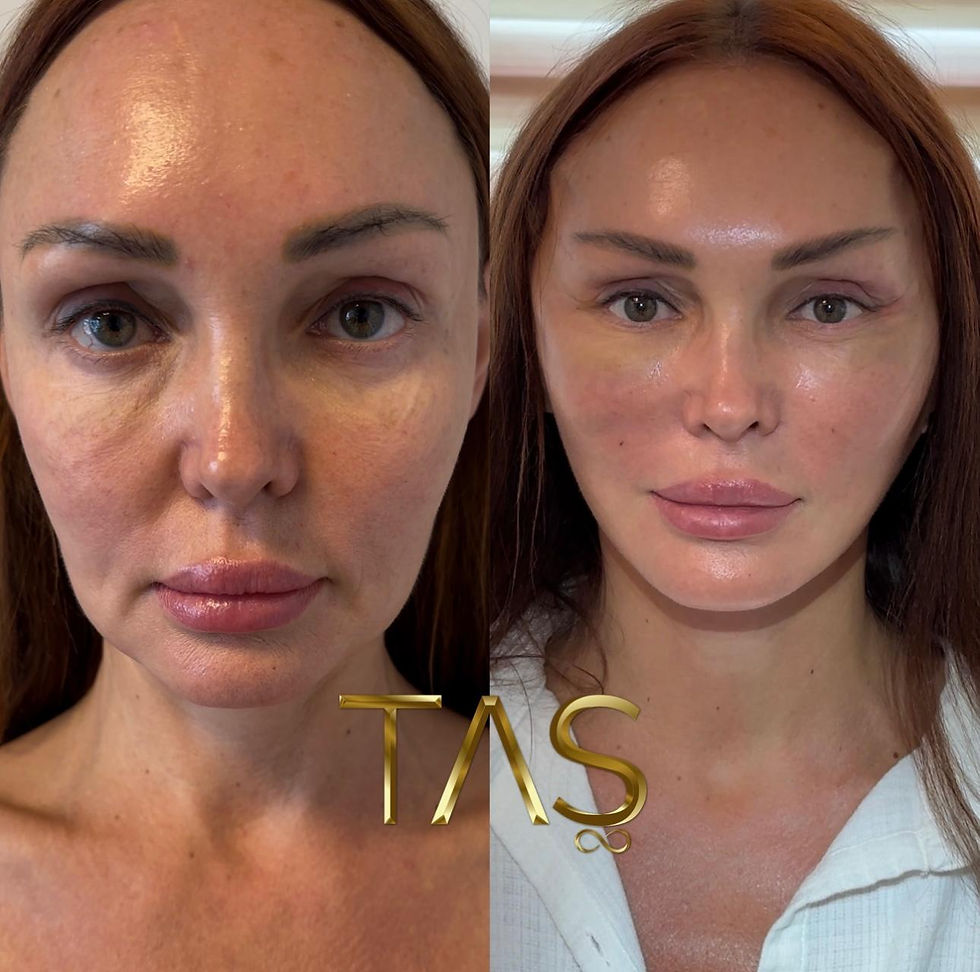
Ten years. The face has aged from its lifted position. Compared with old photographs from before surgery, the difference is usually still obvious, even if it is less dramatic than at one year.


Why some facelifts hold longer than others
Technique
A facelift that only tightens skin pulls against a tissue that has already lost its support, and the skin tends to relax again. Techniques that release and reposition the deeper layers, the SMAS and the ligaments, move the structure that holds the face and carry the skin with them, which is why deeper operations are generally described as longer-lasting. The trade-offs are covered in our comparison of ponytail lift and deep plane facelift and in the guide to full, mini and deep plane facelifts.
Skin quality and genetics
Some people have thicker, more elastic skin that keeps its tension for longer. Others have thinner skin that relaxes sooner. You cannot choose your parents, but the surgeon can choose a technique that does not depend on skin tension to hold the result.
Sun exposure
Ultraviolet light breaks down collagen and elastin. Daily sun protection on the face and neck is the single most useful thing you can do to keep the result, and it is free.
Smoking
Smoking damages the blood supply to the skin and accelerates aging of the skin surface. It also increases the risk of wound healing problems in the first weeks, which is why surgeons ask you to stop before surgery.
Weight fluctuation
Gaining and losing a large amount of weight stretches and empties the tissues of the face. A stable weight makes for a more stable result. Our article on Ozempic face and rapid weight loss explains what fast volume loss does to the face.
Age at surgery
A younger patient has better skin and gets longer with the result, but also has a longer time in which the face will age again. An older patient may see a more dramatic change at the outset. There is no perfect age, only a right moment for each face. See our discussion of the best age for a facelift.
What you can do to protect the result
Use sun protection on the face and neck every day, all year.
Do not smoke or use nicotine products.
Keep your weight stable, and avoid crash diets.
Look after the skin with an appropriate routine, and consider skin maintenance treatments if your surgeon recommends them.
Attend your follow-up visits and keep annual photographs at the same angle, so that changes are measured and not remembered.
Will you need a second facelift?
Some patients choose a second procedure ten to fifteen years after the first, often a smaller one focused on the jawline and neck. Others never do. A second procedure is not a sign that the first failed, it reflects the fact that the face keeps aging. Revision surgery, meaning correcting a problem from the first operation, is a different situation, and is covered in our revision facelift guide.
I ask patients to compare the photograph from ten years after surgery with the photograph they would have taken without it, not with the one they saw at three months. The comparison that matters is the one against the face you would have had.
How to judge your own result at ten years
Take a photograph at the same angle and lighting each year, and compare it with your pre-operative photograph, not with your memory. Most people who do this find that they have aged well relative to their peers and relative to where they started, even if the jawline is not as sharp as at one year.
Frequently asked questions
Does a facelift wear off after 10 years?
It does not wear off in the sense of disappearing. The face keeps aging from the lifted position, so some softening returns, but most patients still look clearly better than they would have without surgery.
How long does a facelift last?
Most patients enjoy a visible improvement for ten years or more, and the duration depends on technique, skin quality, sun exposure, smoking, weight changes and genetics. See our longer article on how long a facelift lasts.
Will I need a second facelift?
Some patients choose a smaller second procedure, often ten to fifteen years later, and others never do. It reflects continued aging of the face, not a failure of the first operation.
Does skin age faster after a facelift?
No. Skin ages at the same biological pace as before, but because the face has been lifted the changes become visible from a better starting point.
Which type of facelift lasts longest?
Techniques that release and reposition the deeper layers, such as a deep plane facelift, are generally described as longer-lasting than operations that only tighten the skin, because they do not depend on skin tension to hold.
How can I make my facelift last longer?
Protect your skin from the sun, do not smoke, keep a stable weight, look after your skin and attend your follow-up visits.
Planning treatment with Prof. Dr. Suleyman Tas
Prof. Dr. Suleyman Tas compares photographs from before surgery, at one year and at later visits, so that patients can see the change over time and decide calmly whether a further procedure is worthwhile. To discuss your own face, use the online consultation form or read about facelift and face aesthetics in Istanbul.
Continue reading in this facelift series
See Prof. Dr. Suleyman Tas's Viral Before and After Results
Before you decide anything, spend a few minutes with the real cases and the real voices. Every photograph above belongs to a patient of Prof. Dr. Suleyman Tas, published with consent, and every review is signed by the person who wrote it.
400 verified patient reviews, with photographs and video testimonials — read what patients say in their own words.
Deep plane facelift and neck lift before and after gallery — the face and neck lift results that made the practice known, case by case.
Happy patient, happy doctor — photographs taken with patients on the day they went home.
Would You Like the Same Result?
If you are considering facial surgery yourself, the next step is a personal assessment. Prof. Dr. Suleyman Tas reviews your photographs, explains which technique suits your anatomy, and tells you honestly whether surgery is the right answer for you at this stage.
Create your consultation with Prof. Dr. Suleyman Tas — Prof. Dr. Suleyman Tas Clinic, Terrace Fulya, Sisli, Istanbul.


Comments